Who Actually Pays for Satellite-to-Phone Service?
Starlink Mobile passed 22 million monthly users in September. What carriers pay SpaceX for them, what the service does, and how many people one satellite beam can serve.

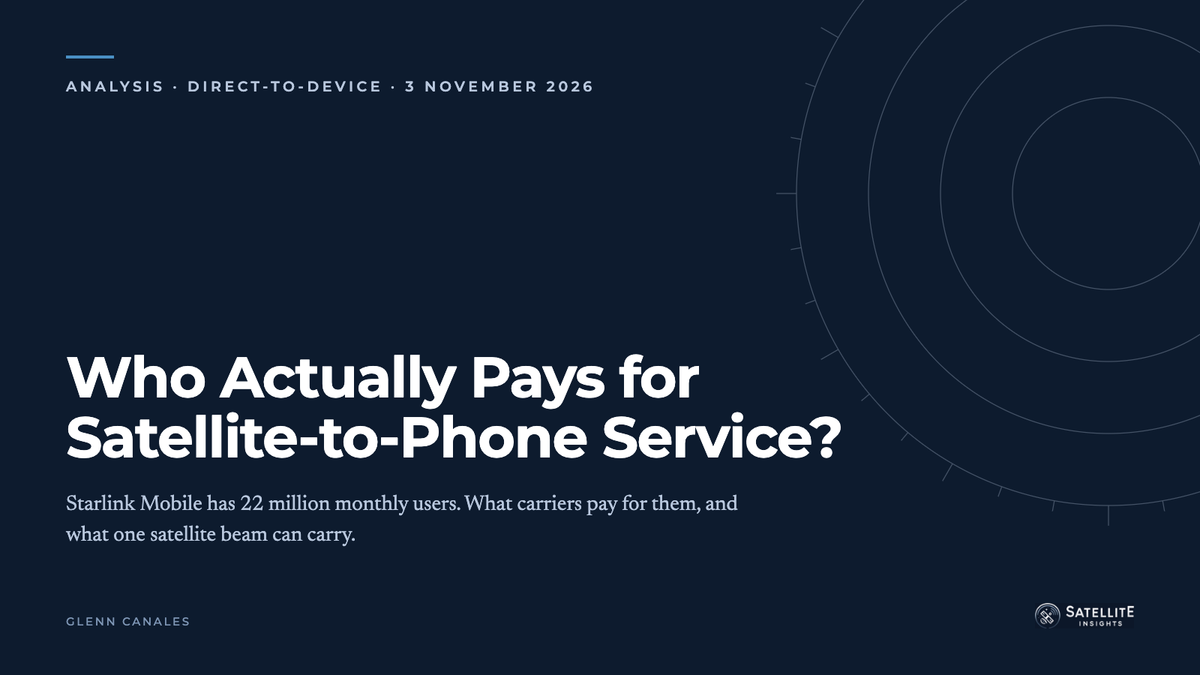
Who Actually Pays for Satellite-to-Phone Service?
Starlink Mobile passed 22 million monthly users in September. Most of the users that can be traced reach it through carriers that include it in a plan or give it away, and the one carrier contract with a reported value works out to a dollar or two per active user a month.
22M
Starlink Mobile monthly users at the end of September, as SpaceX reported on 20 October
$10
T-Mobile’s current monthly price for T-Satellite when a customer’s plan does not include it
$1–2
Analyst Tim Farrar’s estimate of what T-Mobile pays SpaceX per monthly active user
120 Mbps
Megabits per second (Mbps): AST SpaceMobile’s designed peak for one Block 2 beam, shared by everyone under it
SpaceX said on its third-quarter call on 20 October that Starlink Mobile, its satellite-to-phone service, passed 22 million monthly users at the end of September, up 37% in a quarter, according to Chief Operating Officer Gwynne Shotwell. Neither SpaceX nor its carrier partners say how many of those users pay, and the same question applies to AST SpaceMobile, the other company building direct-to-device (D2D) networks for unmodified phones, as it prepares its own service with AT&T and Verizon.
Is direct-to-device overhyped?
Tens of millions of people use satellite-to-phone service, and the business case for the satellite operator is much weaker than that usage suggests. Starlink Mobile, working through carriers such as T-Mobile and Kyivstar, has put satellite texting and a short list of apps on ordinary phones, and AST SpaceMobile is preparing its own service with AT&T and Verizon. Most of the users that can be traced get the service free inside a carrier plan, carriers pay the satellite operator a small wholesale fee, one satellite beam can serve a rural district but not a town, and narrowband uses already run over existing geostationary satellites. The valuations assume satellite operators will one day sell mobile service at retail prices.
The remaining six sections are free with an email address.
No payment, no card. An email address unlocks the rest of this analysis, including the table of what works over satellite and the arithmetic for one satellite beam.
- 02Where the users come from
- 03Who pays
- 04What the service does
- 05What one beam can carry
- 06The machine-to-machine fallback
- 07What the valuations need
Independent weekly intelligence on the satellite communications sector, written from the ground segment up. Unsubscribe in one click.