What Amazon Is Actually Buying at Globalstar
Globalstar books 63% of revenue from Apple and is being sold to Amazon for a sum its revenue cannot explain. The answer is in the spectrum and landing rights.

What Amazon Is Actually Buying at Globalstar
Globalstar books 63 percent of its revenue from one customer, is half-way through replacing its constellation, and is being sold to Amazon for a sum its revenue line does not explain. Apple extended the free tier for a third time on 9 September, in a footnote.
63%
Share of Globalstar total revenue from Apple in 2025, against 58 percent in 2024 and 49 percent in 2023, per the annual report
15%
Network capacity Globalstar retains for every customer other than Apple, per the annual report
US$813.4M
Drawn to date against a customer infrastructure prepayment ceiling of about US$1.58 billion, at 30 June 2026
8 of 17
Replacement satellites launched, on 15 August 2026, and in commissioning rather than carrying traffic
Globalstar booked 126.7 million dollars of service revenue in the first half of 2026. Amazon is buying the company at 90 dollars a share, which values the equity between 11.6 and 11.7 billion depending on whose share count you use. Nothing in that revenue line explains the price, and neither does the subscriber base, which stood at roughly 791,000 at the end of last year.
The reason to look at it this week is a sentence Apple published on 9 September, in the iPhone 18 Pro release, next to the trade-in figures. Apple is extending free access to satellite features for another year, for existing iPhone 14, iPhone 15 and iPhone 16 owners. For iPhone 14 owners it is the third such extension. The terms set in November 2022 ran two years and expired in 2024, iPhone 15 owners were due to lose access this year and did not, and iPhone 16 owners were not scheduled to lose anything yet and were included anyway. Apple has published no price, no tier, and no statement that a charge will ever exist.
Globalstar carries that service. It is also named in the annual report, without euphemism, as the Customer, and it supplied 63 percent of total revenue in 2025 against 58 percent in 2024 and 49 percent in 2023.
What is Amazon actually buying at Globalstar?
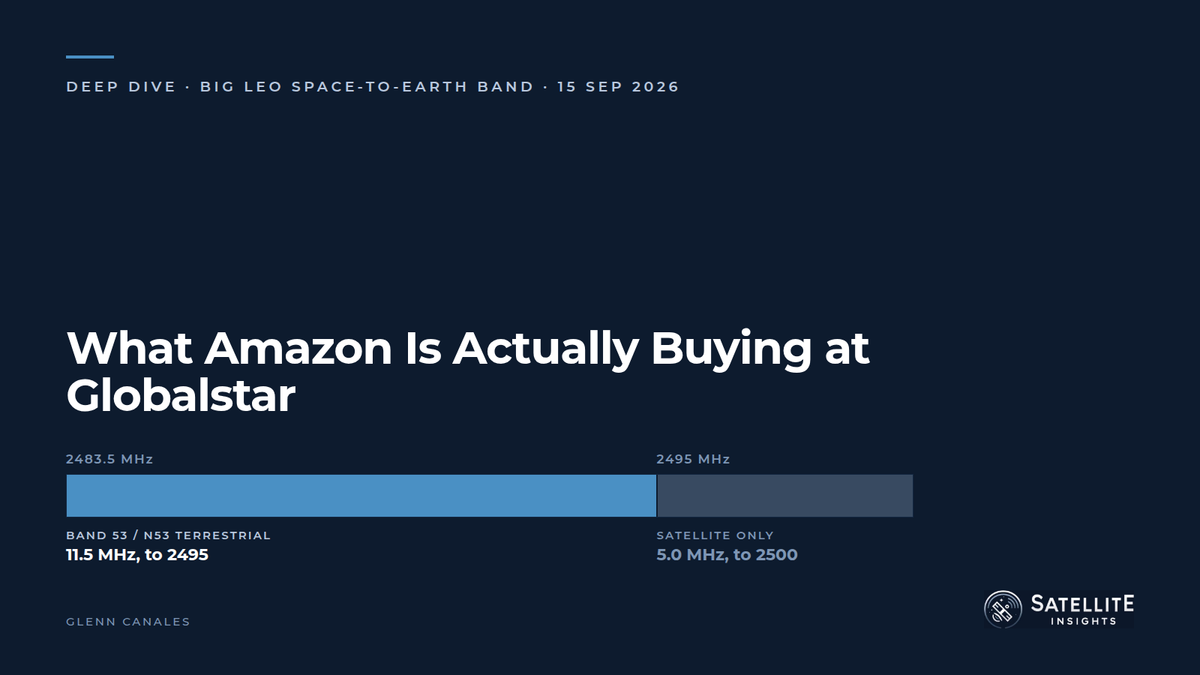
Not the revenue and not the subscribers. A license position that cannot be assembled any other way. The core of it is the 1.6 and 2.4 gigahertz mobile satellite service allocation, one of the few globally harmonized bands of its kind, held on exclusive operating rights the Federal Communications Commission granted in 2007 and its Space Bureau reaffirmed this year. Around it sit landing rights and operating authorizations built up across more than a hundred countries since the original 1995 license, terrestrial broadband authority over 11.5 megahertz in twelve countries, and the rights to a third-generation constellation that is contracted and unflown.
What follows: what Apple actually owns and is losing, the concentration in both directions, a half-replaced constellation gated by four French authorities and the Commission, the asset case in full, and the durability of that 63 percent.
The remaining five sections are for paid members.
The Deep Dive runs the filings, the docket and the asset case in full. Members get it every Tuesday, along with the archive.
- 02What Apple actually bought
- 03Sixty-three percent
- 04Half a constellation
- 05What eleven billion dollars buys
- 06Where I come out
Independent weekly intelligence on the satellite communications sector. No hype. A point of view. Unsubscribe in one click.