Who Gets Bought Next in Satellite M&A. One Seller Has Already Told You
iDirect, Hughes, Iridium, Comtech. Who sells next in satellite M&A, why ground infrastructure clears at a fraction of what spectrum does, and the constraint that now kills more deals than antitrust ever has.

Who Gets Bought Next in Satellite M&A. One Seller Has Already Told You.
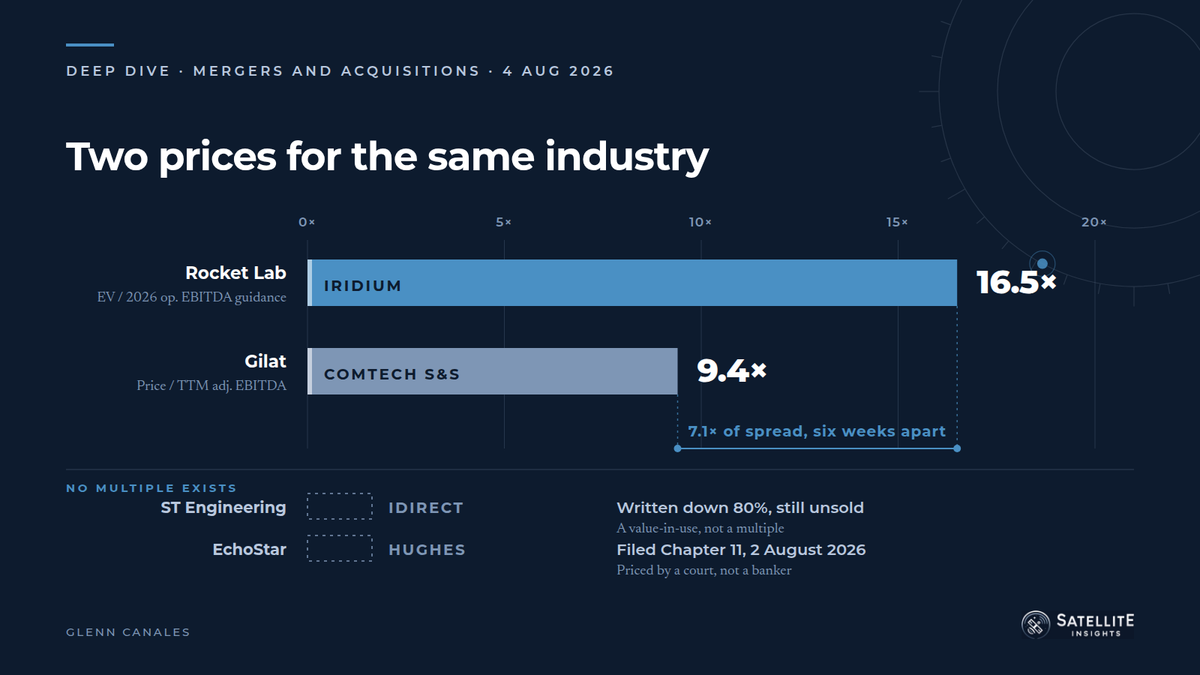
Rocket Lab is paying roughly sixteen times earnings for Iridium. Gilat is paying roughly nine for Comtech's ground business. Same industry, six weeks apart. That gap is the sorting mechanism, and it says exactly which assets change hands next.
~16.5×
Iridium enterprise value to 2026 operational EBITDA guidance, at the announced deal price (29 Jun 2026)
~9.4×
Comtech Satellite and Space price to trailing twelve-month adjusted EBITDA, at the announced deal price (15 Jun 2026)
80%
Share of iDirect's carrying value written off by ST Engineering in a single impairment (12 Nov 2025)
$1.5B
Hughes note that matured 1 Aug 2026 against $102M of cash. Chapter 11 petitions filed the next day.
Three satellite businesses changed hands or went to court this summer. Rocket Lab agreed to buy Iridium. Gilat agreed to buy most of Comtech's Satellite and Space Communications segment. Hughes Network Systems, the satellite operating business inside EchoStar, filed for Chapter 11 on 2 August. Covered as a group, they read as one story about consolidation. Priced as a group, they are two entirely different stories, and the distance between them is the most useful number in the sector right now.
Rocket Lab's offer values Iridium at roughly $8.0 billion in enterprise value against 2026 operational EBITDA (earnings before interest, taxes, depreciation and amortization) guidance of $480 million to $490 million. Call it sixteen and a half times. Gilat is paying $157.5 million in cash for a Comtech unit that produced $195.2 million of revenue and $16.8 million of adjusted EBITDA in the twelve months to 31 January 2026. Call it nine and a half. Both are satellite communications businesses. Both were priced by sophisticated buyers inside six weeks. One cleared at nearly double the other.
Who is the most likely next satellite company to be sold?
ST Engineering iDirect. It is the only sizable asset in commercial satcom with a confirmed seller, a published reserve price and no announced buyer. In November 2025, ST Engineering wrote iDirect's carrying value down from S$837 million to a value-in-use of S$170 million, roughly $133 million at current exchange rates, and told the market it was in active discussions on strategic options including divestment. Nine months later there is still no signed agreement, and the disclosure language has not changed.
Every other name on the industry's who-is-next lists is inference. iDirect is a live process with a number attached to it, disclosed by the seller, in a public filing.
That is the near-term answer. The larger transaction nobody is pricing properly sits at Viasat, where an activist-driven Strategic Review Committee has spent since May 2026 weighing whether to separate the government business from the commercial one. A separation is being debated as a value-unlock question. It is also, mechanically, how you turn one company that is difficult to buy into two companies that are not.
The rest of this piece works through what each of those prices actually bought, why the ground segment is clearing at single digits while spectrum clears at sixteen, what a bankruptcy court rather than a banker will do to Hughes, and which assets sit next in line. It closes on the constraint that now kills more satellite deals than antitrust ever has, which is not competition policy at all.
The remaining eight sections are for subscribers.
No payment, no card. An email address unlocks the full deep dive and every edition after it. If you already have an account, sign in and the rest of the page opens where you are.
- 02What Rocket Lab actually bought
- 03What the ground segment is worth
- 04The forced seller
- 05Who gets bought next, ranked
- 06The Viasat wildcard
- 07What kills deals now
- 08What to watch
- 09Method and sourcing
Independent weekly intelligence on the satellite communications sector. No hype. A point of view. Unsubscribe in one click.
What does sixteen times EBITDA buy in low Earth orbit?
On 29 June 2026, Rocket Lab agreed to acquire Iridium for $54 per share in cash and stock, structured as $27 in cash plus Rocket Lab shares inside a collar of $67.50 to $112.50. The headline enterprise value is roughly $8.0 billion, a 24 percent premium to Iridium's close on 26 June. Part of the consideration is backed by a $3.6 billion, 364-day senior secured bridge from Deutsche Bank and Wells Fargo.
Against Iridium's 2025 revenue of $871.7 million and operational EBITDA of $495 million, and 2026 guidance of $480 million to $490 million, that is a sixteen-and-a-half-times business. Nothing in Iridium's growth profile justifies that multiple on its own. Iridium is a mature narrowband operator with 2.55 million subscribers and a fleet of 66 satellites that was completed in 2019.
What Rocket Lab bought was not the fleet. Satellites are the one part of this that Rocket Lab can already build. What it bought was globally coordinated L-band spectrum, a set of national licenses and International Telecommunication Union (ITU) filings accumulated over three decades, and an installed base of more than 500 partners with equipment already in the field. None of that is manufacturable. You cannot vertically integrate your way into a spectrum position.
Read alongside the rest of 2026, the pattern is consistent. Amazon agreed to acquire Globalstar for about $11.6 billion, roughly $90 per share, which was a 23.5 percent premium to the prior close and Amazon's second-largest acquisition after Whole Foods. SpaceX paid $17 billion for EchoStar's AWS-4 and H-block spectrum. AT&T paid about $23 billion for the 3.45 GHz and 600 MHz licenses, and closed on 28 July 2026. Space Capital's mid-year read makes the same point from the other direction: standalone launch companies are expected to atrophy as launch becomes an enabler of higher-value businesses rather than a product.
The premiums are being paid for licensed, scarce, defensible frequency and orbital position. They are not being paid for satellite operating businesses. That distinction is the entire spread.
Volatile, re-verify before citing. Rocket Lab closed at $63.91 on 24 July 2026, below the $67.50 collar floor and roughly 58% off its high for the year. Below that floor the $54 notional stops being protected: on the deal's terms, each $1 of further decline trims about 40 cents from the stock portion Iridium holders receive. The collar is a benchmark, not a guaranteed price. Check both share prices and the Form S-4 status at time of use. Closing is not expected until mid-2027.
Why is ground infrastructure selling at single-digit multiples?
Gilat's purchase of Comtech's Satellite and Space Communications segment is the cleanest available read on ground-segment value, because both sides disclosed the numbers. $157.5 million in cash, on a cash-free and debt-free basis, for a unit carrying $195.2 million of revenue and $16.8 million of adjusted EBITDA on a trailing twelve-month basis to 31 January 2026. Gilat is funding it entirely from the roughly $170 million of net cash it held at the end of the first quarter. The cyber and services line is excluded. Closing is expected by end-2026, subject to clearance from the Committee on Foreign Investment in the United States (CFIUS), the Federal Trade Commission (FTC), and the Department of Justice under Hart-Scott-Rodino.
The multiple is roughly 9.4 times. But the more revealing number is on Comtech's side of the table. Comtech's blended borrowing rate on its senior and subordinated debt sat above 18 percent as of 30 April 2026. Covenant testing has been suspended through 31 July 2027. Sixty-five percent of net proceeds go straight to prepaying the senior term loan. This is not a portfolio decision. It is a balance-sheet rescue conducted through a divestiture, and the price reflects who needed the transaction more.
iDirect is not even a multiple
ST Engineering did not publish a multiple for iDirect. It published a value-in-use, which is what you disclose when the business is being measured for impairment rather than sale. The carrying amount of S$837 million was written down by S$667 million to S$170 million as of 30 September 2025. Roughly $133 million at current rates, against a book value of about $653 million. IDirect's revenue for the first nine months of that fiscal year was down 9 percent and EBITDA was down 22 percent, on top of a prior-year operating loss. Headcount has since come down by more than 20 percent from around 1,400.
ST Engineering was unusually plain about the cause. The release cited rapid expansion by non-geostationary satellite orbit (NGSO) operators alongside delayed and limited launches by geostationary orbit (GEO) operators. That is the correct diagnosis, and it is worth stating in commercial terms rather than technical ones.
The independent ground-segment vendor business model assumed that somebody else would own the satellites and would need to buy a hub, a modem, and a network management system to light them up. Starlink does not buy a hub. Amazon Leo does not buy a hub. Kuiper-class and Starlink-class operators build their own ground infrastructure because the ground segment is where their cost advantage lives, and because a vertically integrated network is the point rather than an accident. iDirect's addressable market did not shrink because iDirect executed poorly. It shrank because the customer category that bought its product is being replaced by a category that does not.
Which leaves a floor, and the floor is sovereign. On 28 July 2026, ST Engineering iDirect announced defense program awards with ministries of defense in two Southeast Asian countries and three European programs covering infrastructure modernization, tactical mobility and protected maritime communications. Governments still buy hubs, because governments want networks they control. That business is real, it is growing, and it is the reason the eventual buyer of iDirect is far more likely to be a defense-oriented consolidator than an infrastructure fund. It also explains why the asset has not cleared: a defense-heavy ground vendor with multinational sovereign customers is exactly the sort of asset that national security reviewers take a long look at.
What happens to Hughes once a court sets the price?
Hughes Network Systems had a $1.5 billion note due 1 August 2026 with no grace period, and $102 million of cash at 31 March 2026. It did not pay. On 2 August, Hughes Satellite Systems Corporation and certain of its United States subsidiaries, Hughes Network Systems LLC among them, filed voluntary Chapter 11 petitions in the Bankruptcy Court for the Southern District of Texas, Houston Division. The company announced the filings on 3 August. White & Case is counsel, FTI Consulting is financial adviser, and Epiq is the claims agent. There is no prenegotiated plan.
The perimeter is drawn tightly. EchoStar Corporation itself, EchoStar's non-Hughes subsidiaries, and Hughes Satellite Systems' international subsidiaries are all outside the cases. DISH TV, Sling TV and Boost Mobile are unaffected. This is the second Chapter 11 from the EchoStar family in five weeks, after DISH DBS and DISH Wireless filed a prepackaged case on 30 June.
The operating trend underneath is not ambiguous. Hughes broadband subscribers have fallen from 1.56 million at the end of 2020 to 681,000 at 31 March 2026, down 20 percent year over year, with service revenue off 11 percent to $330 million. There is no version of that curve that services $1.5 billion.
The structure is the point
What deserves more attention than the filing itself is how EchoStar arranged the pieces. DISH DBS and DISH Wireless went into a prepackaged Chapter 11 on 30 June 2026. Hughes was deliberately kept outside those cases. Meanwhile the parent monetized roughly $40 billion of spectrum, with the SpaceX transaction approved by the Federal Communications Commission (FCC) on 12 May 2026 and the AT&T transaction closing on 28 July 2026. The spectrum was sold at the parent. The maturity was left at the operating subsidiary with $102 million against it.
That is not a restructuring that went wrong at Hughes. That is the restructuring.
What comes out the other side
The filing announcement is unusually explicit about the destination. Hughes says it intends to refocus operations on enterprise, government and defense lines of business. Read plainly, that is a company telling its creditors it is exiting the consumer broadband business described above, and reorganising around the part a buyer would actually want.
Which makes the reorganised Hughes an asset rather than a casualty. An enterprise and government capacity business with Ka-band coverage over North America, sold out of Chapter 11 with the consumer liability shed and the debt cut, is a cleaner thing to buy than it has been in a decade.
A creditor group retained Glenn Agre before the filing to examine the roughly $190 million per year that Hughes pays EchoStar to lease capacity on Jupiter-3. Single-sourced, and now the hinge for anyone valuing the enterprise business, because a related-party lease inside a live Chapter 11 is exactly the sort of arrangement creditors move to reject or recharacterise. Hughes has been shifting away from residential broadband toward enterprise services for several years. An enterprise capacity business that carries a $190 million annual related-party lease is a very different asset from one where that lease is renegotiated or recharacterized in bankruptcy.
On the headcount
A Maryland WARN (Worker Adjustment and Retraining Notification) filing made in late July 2026 covers 330 EchoStar and Hughes employees across three facilities in Gaithersburg and Germantown, effective 22 September 2026. Higher figures have circulated in industry conversation and on employee forums. The 330 is the number with a government document behind it, and it is the only one this publication will print as fact.
Single-sourced. The 330-person WARN filing is reported by one outlet citing the Maryland Department of Labor. The underlying filing is a public record and should be pulled directly before the figure is reused.
Which satellite businesses are most likely to change hands next?
Ranked by how much of the answer is public record rather than inference.
-
ST Engineering iDirect
Confirmed seller, published value-in-use, no announced buyer, nine months into a disclosed process. The likely acquirer profile is a defense-oriented ground consolidator rather than a financial buyer, because the sovereign and defense book is the durable part of the business. Gilat is the obvious name and the obvious problem: it will be integrating Comtech's segment through 2027 and still needs CFIUS clearance to do it. Kratos and a private-equity-backed defense platform are the other plausible shapes.
-
The Hughes enterprise and Jupiter capacity business
No longer a forecast. Hughes is in Chapter 11 as of 2 August and has said it will reorganise around enterprise, government and defense, which is another way of saying it is packaging the salable part. Priced by a court rather than a banker, which historically produces a lower number and a faster process. Natural buyers are a GEO operator that wants North American Ka-band capacity without building it, or an enterprise managed-services roll-up that wants the customer base. The Jupiter-3 lease treatment determines what the asset is worth.
-
Comtech's retained business
Once the Satellite and Space segment is gone, what remains is a small-cap public-safety technology company, rebranding as Allerium, with roughly $249 million of net sales, $554 million of funded backlog, and a materially cleaner balance sheet. There is no obvious strategic reason for that to stay independently listed. A take-private or a public-safety roll-up is the logical end state.
-
Regional GEO operators without a sovereign shareholder
The sorting mechanism across 2026 has not been scale. It has been whether a state stands behind the equity. Eutelsat got a recapitalization with the French state as its largest holder. Telesat got roughly C$2.54 billion of Canadian federal and Quebec funding for Lightspeed. Hispasat went to Indra. Operators without that backstop face the same capacity oversupply with none of the protection, and they are where the next round of quiet, unpremium transactions will happen.
-
A separated Viasat commercial business
Conditional, but the condition is being actively evaluated by a board committee. See below.
Would a Viasat separation put its commercial business in play?
Disclosure. The author was Senior Director, Enterprise Broadband Services at Viasat from 2016 to 2024. This section draws entirely on public filings, earnings call transcripts and press reporting. No non-public information is used and no position is held.
In early May 2026, Viasat entered a cooperation agreement with the activist firm Carronade Capital and appointed Shekar Ayyar and Jinhy Yoon to a newly formed Strategic Review Committee of the board. The committee's remit, as management has described it, includes evaluating the merits of separating the government and commercial businesses. On the Q2 FY2026 earnings call, Mark Dankberg framed it as weighing a spin-off against strategic partnerships, with deleveraging toward three times as the stated near-term priority.
The number attached to this in sell-side and activist commentary is up to $11 billion of unlocked enterprise value. Treat that as an advocate's figure rather than a market one. It is an estimate produced by parties with a position, and it has not been tested by a transaction.
The value-unlock argument is well covered. The M&A consequence is not, and it runs the other way. Today Viasat's commercial satellite business sits inside a company whose defense and advanced technologies segment generates counter-cyclical, contracted revenue and whose balance sheet is managed as a whole. Buying the commercial business means buying the defense prime, which brings a national security review and a valuation argument about two businesses that trade on different logic.
Separate them and that friction disappears. You get a defense pure-play that re-rates toward its peer group, which is the stated point, and you also get a standalone commercial satcom operator carrying its own leverage into a market where GEO capacity is being written down across the board. The first of those is a value story. The second is an acquisition target, and it would be the largest independent commercial satcom asset available to a buyer since Intelsat.
None of that is a prediction that Viasat separates, or that anyone bids. It is a statement about what a separation would create. Boards evaluating spin-offs are generally aware of it.
What is actually blocking satellite M&A?
Not antitrust. Sovereignty.
The defining precedent was set in France. Eutelsat had agreed to sell 80 percent of its ground infrastructure, roughly 1,400 antennas, to the Swedish private equity firm EQT in a transaction valued in the range of €550 million to €790 million. The French government blocked it. Economy Minister Roland Lescure confirmed on French television on 30 January 2026 that the ground segment was strategic. A willing seller, a willing buyer, a priced deal, and a state veto on the grounds that antennas on French soil are national infrastructure.
The same logic is now distributed across every jurisdiction that matters. CFIUS sits on Gilat's acquisition of Comtech's segment, an Israeli acquirer buying a business whose customers include the US Department of War and which is more than 70 percent US-based. The FCC controls the license transfers in both Amazon/Globalstar and Rocket Lab/Iridium. In Europe, the Airbus, Leonardo and Thales space combination known as Project Bromo faces a review with no decision expected before the second half of 2027.
The rule that has emerged
Capacity and spectrum still cross borders. Ground infrastructure increasingly does not. That asymmetry explains the pricing split better than any argument about growth rates. Spectrum assets are auctioned into a global buyer pool that includes the best-capitalized companies on earth, so they clear at sixteen times. Ground assets are sold into a buyer pool that has been narrowed by nationality before the first meeting, so they clear at nine, or at a value-in-use, or in bankruptcy court.
Enterprise buyers should read that twice. If your hub vendor or teleport provider is a takeover candidate, the set of acquirers that can legally complete the transaction is smaller than the set that would like to. That narrows the field of possible outcomes for a platform you may be committing to for seven years, and it raises the probability that the resolution is a restructuring rather than a clean sale to a well-capitalized strategic. That belongs in the vendor risk section of your next procurement, and in most enterprise evaluations it currently is not there at all.
Six things that will move this picture in the next ninety days
- The Hughes first-day motions, and then whether the Jupiter-3 lease survives contact with creditors. The filing is done; the lease question is what determines whether the enterprise business is worth buying and at what price. Watch for any move to reject or recharacterise it.
- Whether a plan sponsor or stalking-horse bidder emerges for the reorganised Hughes. The case opened without a prenegotiated plan, which leaves the outcome genuinely open rather than pre-agreed.
- CFIUS on Gilat and Comtech. A clean clearance sets the template for cross-border ground-segment deals. A conditioned one sets a different template, and prices iDirect accordingly.
- Whether Rocket Lab shares recover above the $67.50 collar floor before the Form S-4 goes effective. The collar is where a stock-funded deal in a volatile sector either holds or gets renegotiated.
- ST Engineering's next results, specifically whether the iDirect disclosure language changes. "Active discussions" holding for a fourth consecutive reporting period means something different from what it meant in November.
- Whether Viasat's Strategic Review Committee produces a structure or another quarter of evaluation. Activist cooperation agreements have clocks on them.
How the numbers in this piece were checked
Deal multiples are computed from figures disclosed by the parties at announcement and are therefore fixed as of the announcement date, not market-sensitive. Enterprise value, revenue and EBITDA inputs come from the transaction releases and the corresponding SEC filings. Share prices, market capitalizations and any figure that moves daily are dated in the text where used and should be re-verified before being quoted onward.
Specific factual claims are held to a two-source minimum. Two items in this piece remain single-sourced and are flagged where they appear: the Maryland WARN filing covering 330 employees, and the creditor review of the Jupiter-3 lease. The Hughes Chapter 11, reported ahead of the event and carried here as reported in an earlier draft, is now confirmed by the company's own announcement and the petitions docketed in the Southern District of Texas. Currency conversions from Singapore dollars use a rate of approximately 0.78 US dollars per Singapore dollar as of 1 August 2026.
Related reading from the archive: Is iDirect a Smart Buy?, Everyone Is Watching DISH Go Bankrupt. Watch Hughes Instead, Bought, Not Built: Why Rocket Lab's Iridium Deal Isn't the Next Starlink, The Reversal: Gilat Buys the Comtech Business That Once Tried to Buy It, The Week Consolidation Stopped Being a Forecast, Ground Segment in the Space Economy, The Multi-Orbit Mirage, and SpaceX IPO.
You have read this one. The paid editions go further.
Free members get pieces like this one. Paid members get the weekly Deep Dive on the current window, covering LEO broadband, GEO economics, ground segment, direct-to-device and sovereign connectivity, from a forty-year enterprise satcom practitioner. No hype. A point of view.
Upgrade to paid