Amazon Ordered Six More Ariane 6 Launches Days Before the Rocket Was Put on Hold
Amazon Leo expanded its Arianespace order days before Ariane 6's 2026 flights went on hold, with Vulcan and New Glenn already grounded. What it means.

Amazon Ordered Six More Ariane 6 Launches Days Before the Rocket Was Put on Hold
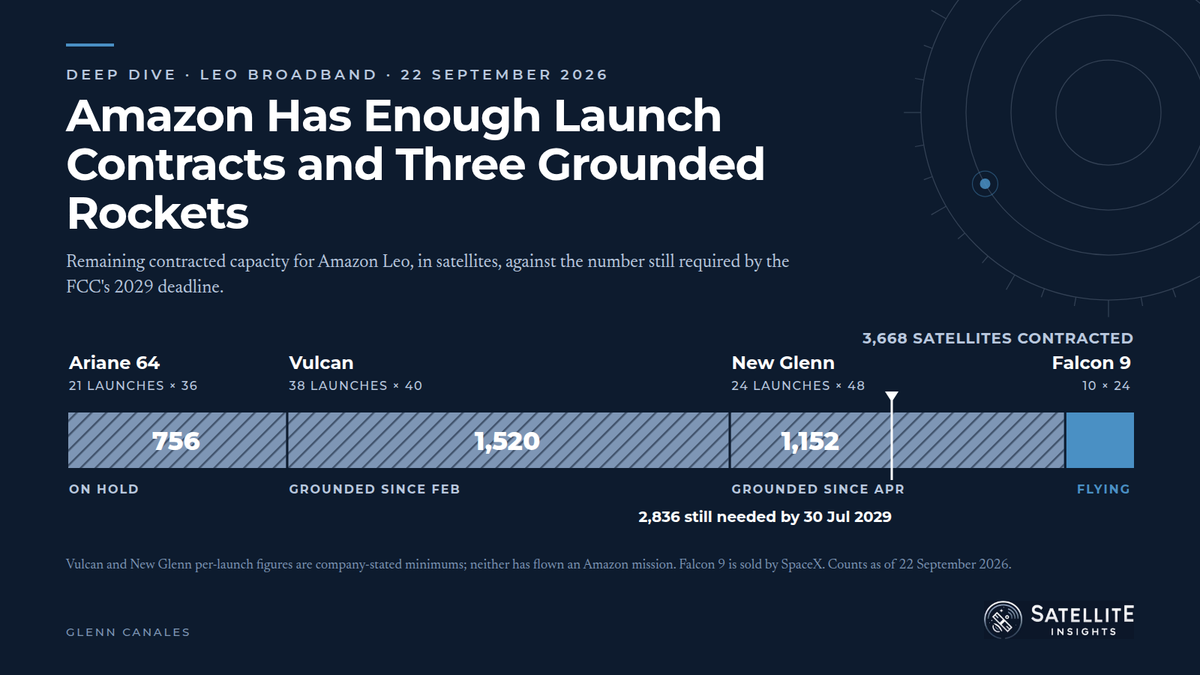
Amazon Leo expanded its Arianespace order to 24 missions on September 9. Within two weeks Ariane 6's remaining 2026 flights were on hold, and it had been the last of Amazon's three heavy rockets still flying, because Vulcan and New Glenn were already grounded. Amazon holds enough launch contracts to finish the constellation, and the months left to fly them are the constraint.
24
Ariane 64 launches Amazon Leo now has under contract with Arianespace, up from 18, announced 9 September 2026
4 of 8
Ariane 6 flights completed in 2026 against the eight Arianespace had targeted, with the remainder on hold
3 of 3
Heavy rockets on Amazon's manifest that cannot currently launch its satellites: Ariane 64, Vulcan and New Glenn
30 Jul 2029
FCC deadline for Amazon Leo's full first-generation deployment, unchanged by the June waiver of the halfway milestone
On September 9, at the International Space Summit in Paris, Amazon Leo and Arianespace announced six more Ariane 64 launches, which takes Amazon's booking on Europe's heavy rocket from 18 missions to 24 and stretches the schedule through 2031. Amazon Leo is the low Earth orbit (LEO) broadband constellation formerly called Project Kuiper, and it is now Arianespace's largest single customer. Eight days later the French business daily La Tribune reported a technical problem with an unnamed Ariane 6 component. Space Intel Report identified it the next day as an engine turbopump, found during ground checks in August, and said the rocket would probably fly once or twice more this year rather than the three or four times that had been planned. On September 21 the European Space Agency (ESA) confirmed it knew of the delays, and ArianeGroup and Arianespace said this year's mission schedule would have to be adjusted while additional checks run on the production line.
A slip of two or three flights on one rocket would normally be Arianespace's story, and this one is Amazon's because of what was already true on the day the order was signed. The Atlas V rockets Amazon bought from United Launch Alliance (ULA) are all used. The Vulcan that replaces them has not flown since a booster anomaly in February. Blue Origin's New Glenn has been down since a failed flight in April and a pad explosion in May. Ariane 6 was the one heavy vehicle on Amazon's manifest that had been delivering.
What happened to Ariane 6, and why does it land on Amazon?
Ariane 6 has flown four times in 2026, three of them for Amazon Leo, and its remaining flights are on hold while an engine turbopump anomaly reported by Space Intel Report is checked, against a target of eight flights this year. The companies have confirmed the schedule change and the additional checks but not the component. For Amazon the timing matters more than the fault: Ariane 6 was the last of its three contracted heavy rockets still launching, after ULA's Vulcan was grounded in February and Blue Origin's New Glenn in April. Amazon has not put a satellite in orbit since July 2, and the fourth vehicle on its manifest, the Falcon 9, belongs to the competitor it is trying to catch.
The sections that follow take the evidence in order. First, what ArianeGroup and Arianespace have actually said, which is less than the reporting and worth reading closely. Then a vehicle-by-vehicle table of Amazon's launch contracts, showing what each rocket has flown, what it still owes and what is keeping it on the ground. Then the arithmetic: how many satellites Amazon needs in orbit by which Federal Communications Commission (FCC) date, what pace that implies, and how that pace compares with the best stretch the program has managed. Then the other payloads waiting for the same rockets, including European government missions that have a claim on the one or two Ariane 6 flights left this year. My own read comes last, with the five dates that would change it.
The remaining five sections are for paid members.
The full analysis works through what ArianeGroup and Arianespace have and have not confirmed, a vehicle-by-vehicle table of Amazon's launch contracts, the deployment arithmetic against the FCC dates, the other payloads waiting for the same rockets, and where I come out. If you already have a paid account, sign in and the page opens where you are.
- 02What the companies say
- 03Which rocket can fly
- 04The deployment arithmetic
- 05Who else is in the line
- 06Where I come out
Independent weekly intelligence on the satellite communications sector. No hype. A point of view. Unsubscribe in one click.