Starship reached orbit with 26 Starlink V3 satellites. Here is what they cost everyone else.
SpaceX's Starship Flight 14 reached orbit with 26 Starlink V3 satellites on September 28, 2026. What ten times the capacity per satellite means for OneWeb, Amazon Leo, Telesat, SES and Viasat, and why the FCC's spectrum vote matters as much as the launch.

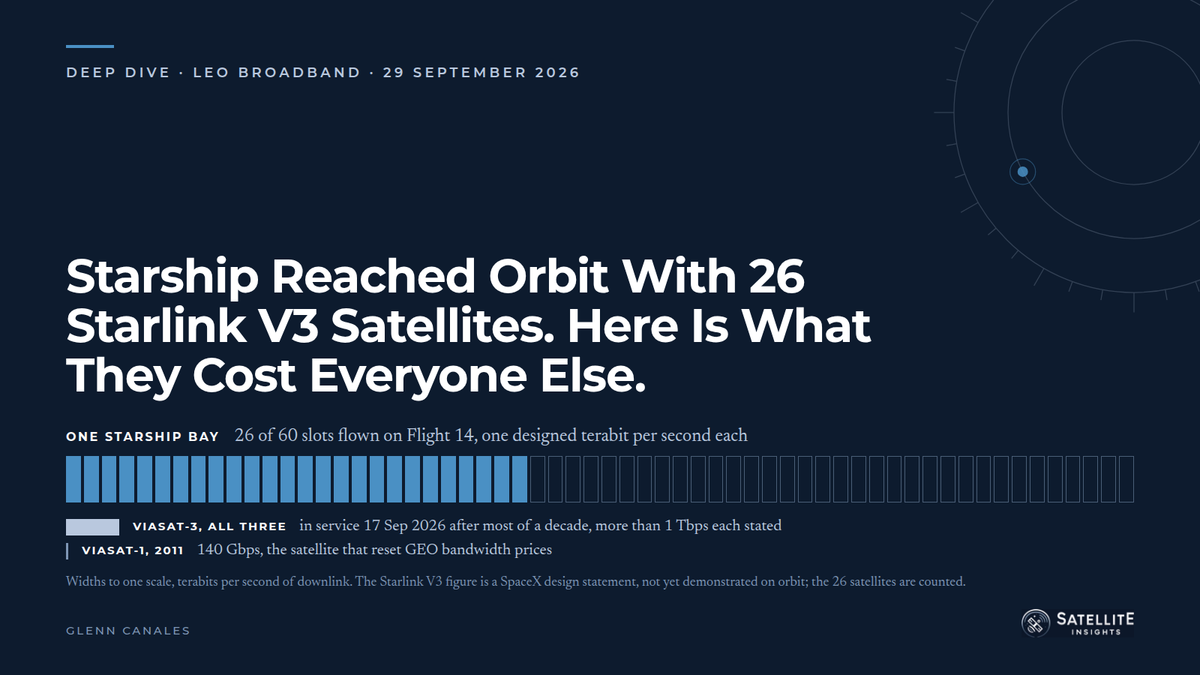
Starship Reached Orbit With 26 Starlink V3 Satellites. Here Is What They Cost Everyone Else.
Flight 14 put the first operational V3 satellites in orbit on Monday, then brought the ship home after one orbit instead of six without saying why. For Eutelsat OneWeb, Amazon Leo, Telesat, SES and Viasat the story is the unit economics, and the clock on those is now set by orbit raising and by Wednesday’s FCC vote.
26
Starlink V3 satellites deployed on Flight 14, all operating nominally per SpaceX
~1 Tbps
Designed downlink per V3 satellite, a company figure not yet demonstrated on orbit
10x
Designed downlink versus a V2 satellite, per SpaceX
1 of 6
Orbits completed before an early deorbit; six were planned and SpaceX has not said why it came back
On September 28, 2026, SpaceX’s Starship Flight 14 became the first Starship mission to reach orbit and the first to deploy operational Starlink satellites: 26 of the new V3 generation, which SpaceX rates at about 1 terabit per second (Tbps) of downlink each, roughly ten times a V2 satellite. The ship reached orbit after one of its engines shut down early on ascent, released all 26 satellites, and came home after one orbit instead of the six planned; SpaceX has not said why.
What did Flight 14 change for the rest of the industry?
The unit economics, not the launch. For Eutelsat OneWeb, Amazon Leo, Telesat Lightspeed, SES, Viasat and the direct-to-device (D2D) operators, a single Starship flight now adds designed capacity comparable to several geostationary (GEO) high-throughput satellites, and once that capacity is raising orbit, the price every competitor has to meet in aviation, maritime, enterprise and government markets moves with it. The early return is a question about Starship’s cadence rather than about whether V3 has arrived, which it has.
This edition works through what was demonstrated on the day, what remains a design claim, which market segments feel it first, and why the Federal Communications Commission (FCC) vote on Wednesday matters as much as the launch.
The full analysis, sections 01 through 06, is for paid members.
The Deep Dive is the paid edition of Satellite Insights Weekly: the as-flown timeline, the designed-versus-demonstrated numbers, the GEO precedent, operator-by-operator exposure, the FCC spectrum item and the verdict. Members also get the archive as each edition ages out of the paywall.
- 01What Flight 14 had to prove, and what it did
- 02V3 by the numbers: designed versus demonstrated
- 03The GEO precedent: the last time capacity jumped tenfold
- 04Who is exposed, segment by segment
- 05Spectrum is the next bottleneck: the FCC vote on September 30
- 06What to watch, and where I come out
Independent weekly intelligence on the satellite communications sector from a forty-year practitioner. No hype. A point of view. Cancel in one click.