Everyone Is Watching DISH Go Bankrupt. Watch Hughes Instead - Deep Dive Weekly
DISH's bankruptcy is the headline. Hughes' August 1 debt maturity is the enterprise story with a date on it. Why it matters for JUPITER capacity.

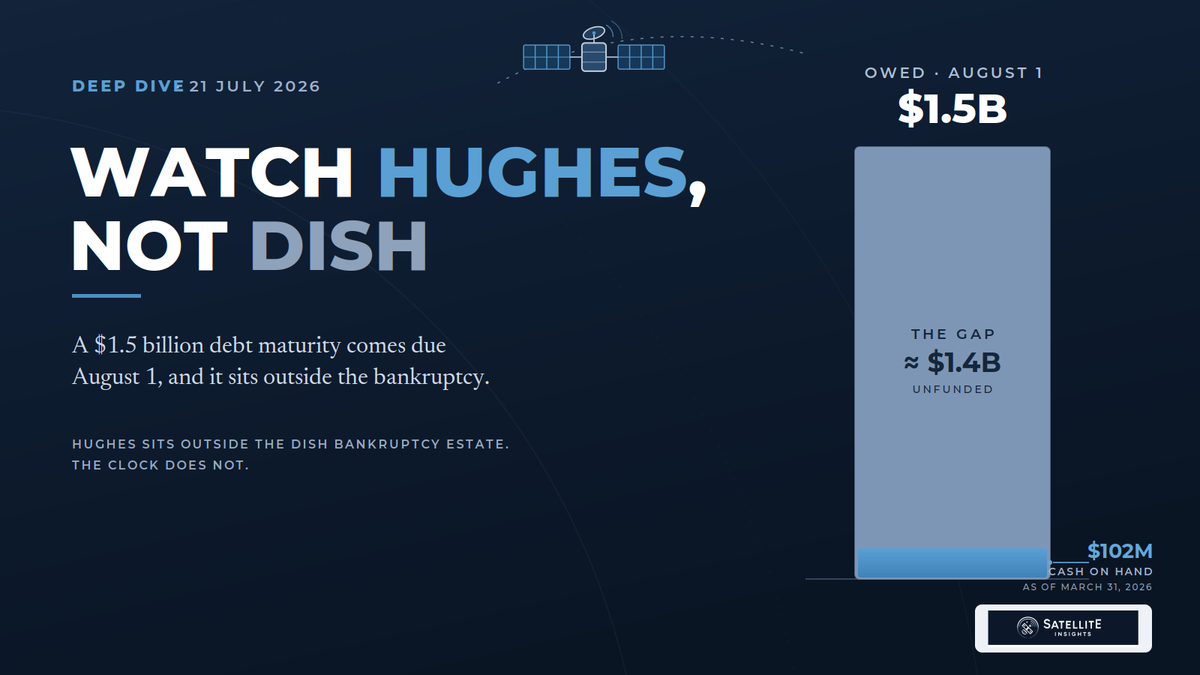
Deep Dive · No. 12–19 July
Everyone is watching DISH go bankrupt. Watch Hughes instead.
The consumer story is the headline. The enterprise story is the one with a date on it: August 1.
★ Most significant event of the week
Hughes Network Systems has $1.5 billion due on August 1, and it is not inside the DISH bankruptcy.
The month's coverage has fixed on the prepackaged Chapter 11 filings at DISH DBS and DISH Wireless, and on Charlie Ergen stepping back into day-to-day command after Hamid Akhavan left on July 6. That is the loud story. It is not the one that touches anyone who sells or buys managed enterprise connectivity.
Hughes carries a $1.5 billion maturity due August 1, 2026, on its 5 1/4% senior secured notes. Hughes sits outside the DISH bankruptcy estate. It reported roughly $102 million in cash at the end of March. Its own filing already carries going-concern language. You do not retire a billion and a half against a hundred million and a hope, so something has to give in the next twelve days: a refinancing, an asset or spectrum sale, or a filing of its own.
The question nobody covering the DISH bankruptcy is asking: what happens to Hughes as an enterprise broadband and managed-network operator, and to the JUPITER capacity its HughesON customers depend on, if the fix is a carve-out or a sale rather than a quiet refinancing?
01 / The leadWhy is the Hughes maturity the story, and not the DISH bankruptcy?
Because the two problems live in different boxes, and only one of them is being solved in bankruptcy court. The DISH DBS restructuring is a legacy pay-television debt problem with a documented plan behind it and holders of the great majority of the notes already on board. It is ugly, but it is orderly. Hughes is the one with an unscheduled cliff.
Here is what I can stand behind from the filings and the reporting, separated from what I cannot. The maturity itself is primary-sourced: the Hughes Satellite Systems Corporation quarterly filing states plainly that roughly $1.5 billion comes due in August 2026, and that the company lacks the cash on hand or committed financing to meet obligations across the coming year, which is the language that triggers a formal going-concern warning. Trade coverage from Advanced Television and SatNews carried the same numbers through the winter. What traces to a single Wall Street Journal report, relayed by Seeking Alpha on July 6, is narrower and more specific: that Hughes creditors have retained restructuring counsel at Jones Day. Treat the retention as one-source until a second confirms it. Treat the maturity as fact.
The maturity is fact. The lawyers are one source. Keep those two claims in separate drawers.
Now the part that actually decides the outcome, and the part the headline coverage skips. EchoStar spent the spring lining up spectrum sales to AT&T and to SpaceX. Those approvals matter here because they are the most plausible source of the cash that clears August 1. Advanced Television put it bluntly back in May: the maturity problem might be solved now that the capacity sales to AT&T and SpaceX have cleared regulators. So the enterprise question sharpens into something concrete and answerable. Does Hughes reach into spectrum-sale proceeds to retire the notes, and if it does, how is that value allocated across an intercompany structure where the JUPITER 3 satellite is owned by EchoStar and leased back to Hughes for roughly $190 million a year, rather than owned cleanly in one place?
That intercompany lease is the hinge. If Hughes is refinanced in place, HughesON enterprise customers renew and nobody outside the finance desk notices. If Hughes is carved out or sold to satisfy creditors, the JUPITER 3 lease economics get repriced by whoever ends up holding the paper, and every multi-year managed-network contract on that capacity inherits renewal risk it did not sign up for. That is not a consumer-broadband story. That is a procurement story, and it belongs to the people who read this publication.
What would change the call
A clean refinancing announcement moves this back to a footnote. A Hughes-level asset or spectrum sale, or a missed August 1 payment, moves it to the front page for the right reason. I will be watching the docket, not the DISH one.
02 / Consensus, read against the grainWhat did AST SpaceMobile actually tell us this week?
Two things landed together on July 15, and the market read them as one. AST SpaceMobile moved its commercial direct-to-device (D2D) service target to early 2027, from a prior late-2026 date, and it priced $1.0 billion of 1.625% convertible senior notes due 2034. Both are real. Only one is interesting to us, and it is not the one that moved the stock.
The financing is clean enough on its own terms: about $983.6 million net, an initial conversion price near $79.57 set at a twenty percent premium to the July 15 close, and a capped call taking the effective cap up to $149.20. The notes settled July 20. The stock did what stocks do when a company raises a billion dollars and pushes a launch date out in the same breath. It fell from the July 15 close of $66.31 into the mid-fifties, touched down around 16 percent lower intraday on July 17, and steadied near $58 by Friday, closing Monday, July 20, essentially flat at $57.42. At that close the company was worth roughly $22.3 billion, a figure I am dating precisely because it will be wrong by the time you read this, and because volatile numbers do not belong in a headline.
Here is the read I have not seen elsewhere. The deferral is not new information about AST's physics or its engineering. It is new information about its calendar, and the calendar has slipped before. The honest way to price this is to stop treating AST's published service dates as commitments and start treating them as aspirations with a launch-vehicle dependency stapled to them. The proximate cause this time was upstream: a New Glenn upper stage destroyed in a static-fire ground test in late May, following the April loss of BlueBird 7 on the same vehicle. When your service date depends on somebody else's rocket qualifying, your service date is a forecast, not a plan.
Stop reading AST's service dates as commitments. Read them as forecasts with a rocket stapled to the bottom.
And while the date slipped, look at what did not. The revenue AST is actually booking runs through its ground segment and its government relationships, not through a consumer D2D service that does not yet commercially exist. The company states fifteen gateways delivered across five continents (its figure, not independently audited) and more than $1.2 billion in contracted commitments. The next three satellites, BlueBird 11 through 13, are manifested on a Falcon 9 in the first half of August, which would bring the operational fleet to thirteen. That launch, not the notes, is the catalyst worth marking on a calendar.
One discipline I insist on with AST, because the coverage almost never does. The 98.9 Mbps figure the company likes to cite is a demonstrated peak, achieved in orbit over open water. The two-hundred-megabit numbers attached to the larger satellites are design targets. Those are different categories of claim, and collapsing them is how a licensing spec ends up quoted as a product spec.
03 / The thesis, restated with new evidenceNearly 140,000 satellites filed. So what actually got sold?
The Federal Communications Commission's (FCC) third processing round for non-geostationary systems in the Ku, Ka and V bands closed July 6. The tally is genuinely large: close to 140,000 satellites across thirteen constellations, from SpaceX's 100,000-satellite Gen3 filing down through new entrants like CesiumAstro's 737-satellite Synchronicity. The trade press covered it as a spectrum land-grab and a paper-constellation parade, which it partly is. Most of these will never fly.
That framing misses the part that pays. Every serious constellation in that round just committed itself, on the record, to building or leasing a global network of gateways, teleports and optical ground stations. The satellites are the part everyone photographs. The ground segment is the part that has to exist before a single one of those satellites carries revenue traffic, and it is the layer where margin actually accrues over a decade. This round is not really a satellite order book. It is a gateway order book with satellites attached.
The tell is in the filings themselves. CesiumAstro described an open-terminal strategy for Synchronicity, supporting compatible terminals from more than one vendor. That is the open-ground-systems direction the DIFI and WAVE communities have been pushing toward, and it is the mechanism by which operators who cannot match SpaceX and Amazon on satellite scale can still compete: standardize the ground layer, commoditize the hardware, and compete on the network rather than the dish. I have argued the ground-segment-as-margin case in this publication more than once. A 140,000-satellite filing round is the largest single piece of supporting evidence to cross the wire this year.
Note the throughput claims for what they are. SpaceX's one-terabit-per-satellite Gen3 number is a design figure in a licensing petition, not a demonstrated result. Same category as every other capacity headline in the round.
04 / Watch item, not a leadEutelsat filed "Next." Does it change anything yet?
Through its WorldVu subsidiary, Eutelsat filed on July 6 for "Eutelsat Next," a 528-satellite low Earth orbit (LEO) constellation at 1,220 kilometers, the same altitude as the existing OneWeb fleet, described as separate from but interoperable with it. The design calls for up to 140 Ku-band user beams per satellite, on-board processing, optical inter-satellite links that "may" be available, and roughly fifty gateway earth stations worldwide.
I am keeping this on the watch list rather than promoting it to a lead, and I want to be explicit about why, because the discipline is the point. None of the four triggers I set for this filing has tripped. There is no V-band request in the petition, on the reporting available. There is no named Gen2 manufacturer or manufacturing contract attached to Next specifically. There is no primary licensing file number on public notice that I can locate. And there is no Next-specific financing line; Eutelsat's recent refinancing work points at OneWeb replacement, not at this. A market-access petition is a statement of intent. It is not a program until at least one of those four things is real.
Worth holding in view alongside it: the French government blocked Eutelsat's roughly $831 million ground-station sale-and-leaseback with EQT earlier this year. When a state steps in to keep ground infrastructure from changing hands, that tells you something about who now regards the ground segment as strategic. It is the same thesis from section three, arriving from the sovereign direction.
05 / Around the dialWhat else moved, and what to file it under
The FCC opens an unlicensed-spectrum path for D2D. Chairman Brendan Carr proposed examining more than 225 MHz of unlicensed spectrum to complement direct-to-device services, and clarifying that Part 15 unlicensed devices, meaning Wi-Fi, Bluetooth and low-power sensors, may operate through authorized spacecraft. Lightly covered, and the under-appreciated angle is satellite Internet of Things (IoT): an unlicensed path could undercut the economics of licensed mobile-satellite IoT before that market has finished forming. Filing it under "watch."
Viasat demonstrated an automotive satellite voice call with BMW. First integrated capability of its kind, announced July 16. I note it as context rather than a lead, because automotive mobility sits outside this publication's primary lane, and because one demonstration is a demonstration, not a deployment. The relevant discipline is the same one I applied to AST: Viasat's maritime NexusWave terminal recorded more than 250 Mbps in sea trials, which is demonstrated; the thousand-plus-beam figures on ViaSat-3 are design.
IRIS² re-affirmed, not re-announced. Trade coverage restated the SpaceRISE concessionaire arrangement for the European Union's sovereign constellation. It is a status re-affirmation of language signed in December 2024, roughly 290 satellites and about €10.5 billion, service around 2030. No new news, real sovereign-connectivity relevance, filed accordingly.
Starlink V3 rides Starship. SpaceX manifested the operational debut of the V3 bus, with a design baseline near one terabit per satellite. Design, not demonstrated. Market-share projections attached to it in the trade press are speculation, and I am treating them that way.
Standing watch items — status this week
Eutelsat "Next" (528 sats, 1,220 km). Filed July 6. No elevation trigger tripped: no V-band, no named Gen2 manufacturer, no ICFS file number on public notice, no Next-specific financing. Stays a watch item.
EchoStar / Hughes August 1 maturity. Escalating into the deadline. Maturity primary-sourced; Jones Day retention single-sourced to WSJ. Spectrum-sale proceeds are the plausible clearing mechanism. The opening card this week.
AST SpaceMobile ground segment. No new gateway or commercial-service milestone in the window. Next real catalyst is the early-August Falcon 9 carrying BlueBird 11–13 to a 13-satellite fleet.
On the numbers
Every market capitalization, share price and valuation in this edition was pulled from live sources on July 20, 2026, and dated at the point of use. Volatile figures are kept out of headings and metric cards by policy, and appear only in body text with a date attached. Where a claim rests on a single source, it is labeled as such. Company-stated figures, including AST's gateway count and contracted-commitment totals, are identified as company-stated and are not independently audited. Throughput and capacity claims are marked designed or demonstrated throughout.


