What Ukraine's Starshield Speed Limit Tells Commercial Starlink Customers
Terminals used by Ukraine's forces lost their link above 100 mph, and every government involved disclaims the order. What that shows a business buyer about who sets a terminal's limits.

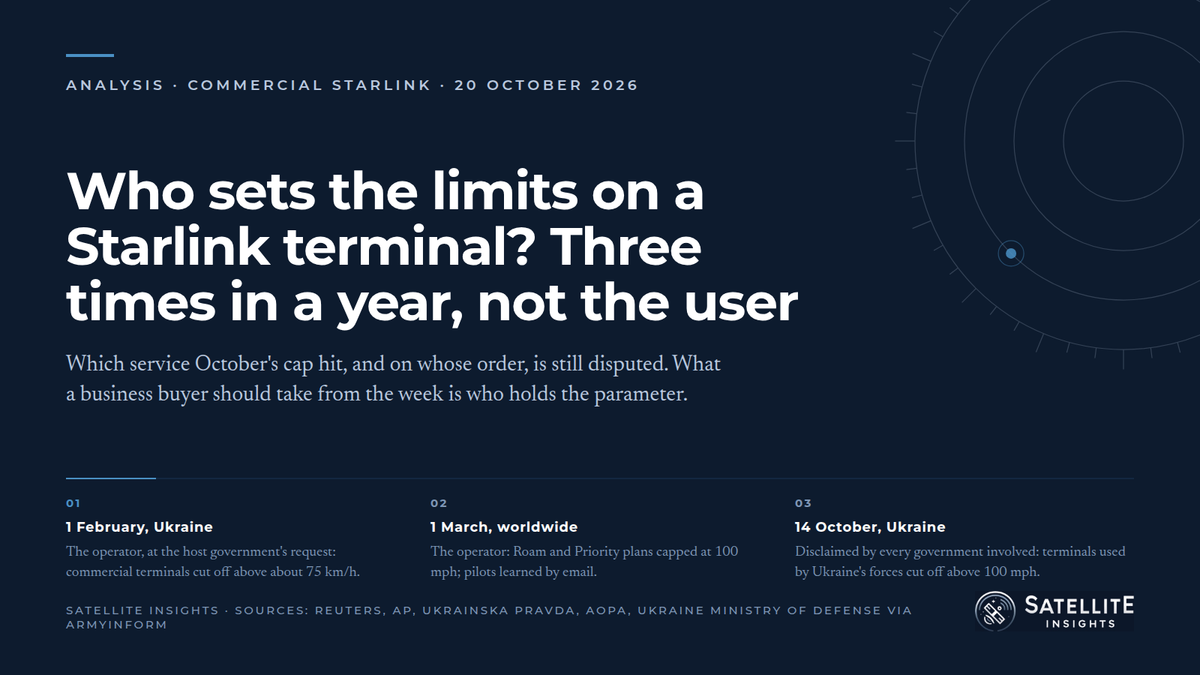
What Ukraine’s Starshield Speed Limit Tells Commercial Starlink Customers
Terminals used by Ukraine’s forces lost their connection above 100 miles per hour on the night of 13 to 14 October, and the users found out from their equipment. Whether they were Starshield or commercial Starlink terminals is now disputed by the governments involved. What the week shows a business buyer is who sets the limits on a Starlink terminal, and how fast they can change.
100 mph
Speed above which terminals used by Ukraine’s forces lost their connection from 14 October, about 161 kilometers per hour, with no advance warning to the users.
1 Mar
Date SpaceX capped its commercial Roam and Priority plans at the same 100 miles per hour worldwide, moving faster use onto aviation plans.
3
Times inside a year the operating envelope of Starlink terminals was changed by someone other than the user: the operator, the operator at a host government’s request, and in October a change each government involved has disclaimed.
1 month
Notice of materially adverse changes promised in Starlink’s aviation terms. The clause a business buyer on any other plan should ask for.
On the night of 13 to 14 October, the Starshield network began cutting the connection of terminals used by Ukraine’s armed forces once they moved faster than 100 miles per hour (about 161 kilometers per hour). Starshield is the government version of Starlink, sold to the United States (US) Department of Defense and running over the same constellation. Reuters reported on 15 October, citing US and Western officials, that the instruction reached Pentagon leaders from inside the White House, which a senior US official denied for the president personally. Elon Musk’s public answer drew a line between the two services: Starshield, he wrote, is “owned and controlled by the US government,” while commercial Starlink is controlled by SpaceX and limited to civilian or defensive use.
Did the Starshield restriction affect commercial Starlink service?
The record is now disputed. Ukrainian officials and Musk said the cap applied to the Starshield service package, and Serhii Sternenko, the volunteer and former defense ministry adviser who first reported it, said stationary terminals kept working [1S]. On 17 October Secretary of State Marco Rubio said Ukraine does not currently have access to Starshield, which he called a military product, as distinct from Starlink, “a commercial product”; his account implies the terminals that lost service were commercial ones, which sits uneasily with the 2024 Pentagon contract that expanded Ukraine’s Starshield access (Bloomberg). Commercial Starlink has its own limits as well: since 1 March SpaceX has capped its Roam and Priority plans at the same 100 miles per hour worldwide, Ukraine’s commercial terminals have run under a separate limit since February, and Starlink’s commercial terms let SpaceX change service specifications and terminate service for reasons that include government authorizations. For a business buyer the lesson of last week is who sets a terminal’s operating limits, and how fast they can change.
The remaining five sections are free with an email address.
No payment, no card. An email address unlocks the rest of this analysis and everything after it. If you already have an account, sign in and the page opens where you are.
- 01What was restricted, and is it lifted?
- 02Who sets a terminal’s limits?
- 03Has commercial service been limited?
- 04What the commercial terms say
- 05What a business customer should take
- Where I come out
Independent weekly intelligence on the satellite communications sector. A point of view. Unsubscribe in one click.


