Deep Dive: Starcloud's Orbital Data Center Math Needs a $30 per Kilogram Launch
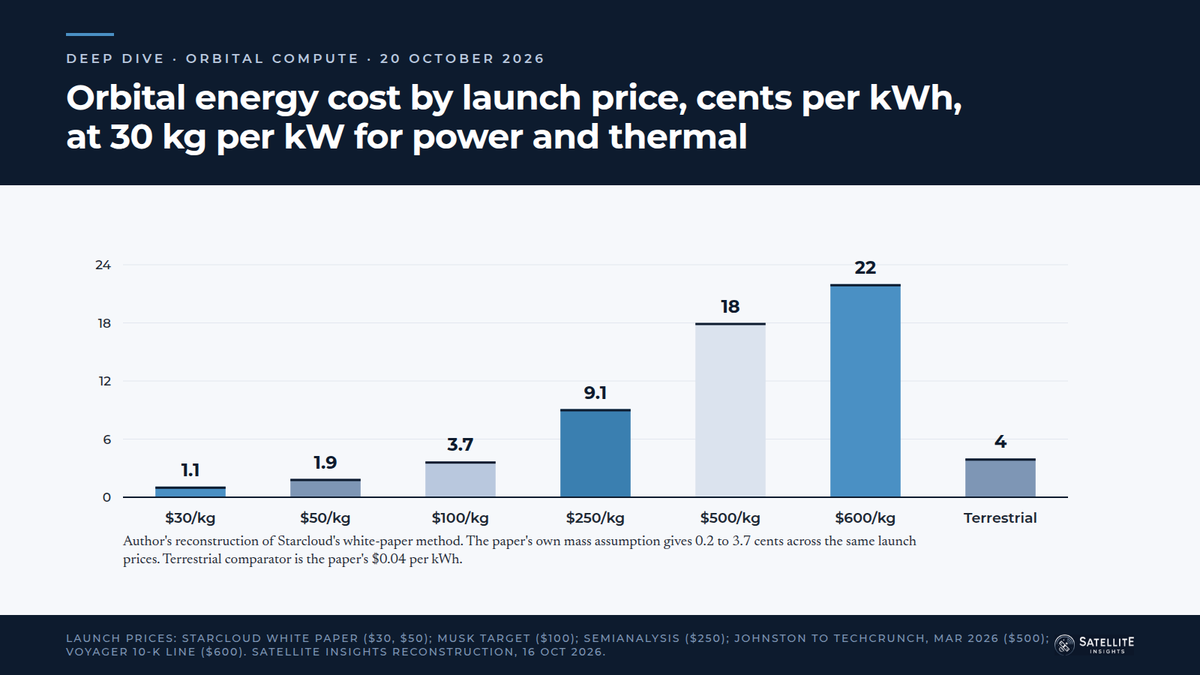
Starcloud's white paper puts a data center in space at one twentieth of the cost of one on the ground. Rerun with 2026 launch prices and spacecraft mass, the same arithmetic gives two to five times more.

Starcloud’s Orbital Data Center Math Needs a $30 per Kilogram Launch
Starcloud’s 2024 white paper says a data center in space costs one twentieth of one on the ground. Rerun with the launch prices and spacecraft masses on the record in 2026, the same arithmetic puts orbital energy at two to five times the terrestrial price, and the company’s chief executive has already said as much.
$30/kg
Launch price the white paper’s cost case rests on. SpaceX’s own stated Starship target starts at $100 per kilogram, and no customer has been offered either.
70 kW/t
Power per tonne of SpaceX’s published AI1 compute satellite. Starcloud’s design assumes about 200, two to three times lighter per kilowatt.
$0.05/kWh
Orbital energy cost Starcloud’s chief executive gave TechCrunch in March at about $500 per kilogram, above the $0.04 terrestrial figure the white paper set out to beat.
2027
Year Starcloud-2, now two 8 kW satellites on rideshare flights, is due. It is the first point at which the designed column has to start moving into the demonstrated column.
Starcloud has one satellite in orbit, Starcloud-1, an 88,000-satellite application in front of the Federal Communications Commission (FCC), and a 2024 white paper, still linked from its homepage, that says a data center in space costs one twentieth of the same data center on the ground. Nvidia, which supplies the chips, is also an investor. SpaceX, which would supply the rocket, has filed for an orbital compute constellation of its own, Starmind. This edition takes the white paper, runs its arithmetic with 2026 inputs, sets the result beside the independent cost models published this year, and then checks it against what the company’s own chief executive has said since.
Is a data center in space cheaper than one on the ground?
On the company’s own arithmetic with 2026 inputs, no. The white paper’s headline result depends on a launch price of $30 to $50 per kilogram and a spacecraft two to three times lighter per kilowatt than SpaceX’s own published design, and seven to twelve times lighter than the independent engineering range. Neither exists. At the launch prices a customer could plausibly negotiate once Starship flies routinely, and at the mass budgets the physics supports, the same arithmetic puts orbital energy at two to five times the terrestrial price it was meant to undercut, and Starcloud’s chief executive said as much in March. The one thing Starcloud has demonstrated, an H100-class graphics processing unit (GPU) running in low Earth orbit (LEO) for most of a year, is real and unmatched with that class of part by anyone else in orbit. Everything past that point is design, filing, and capital.
The remaining nine sections are for paid members.
Deep Dives are the paid tier of Satellite Insights. Members read the full analysis the day it publishes; it moves to free members and then to the open web on the usual rotation. If you already have a paid account, sign in and the page opens where you are.
- 01Demonstrated versus designed
- 02The white paper, reconstructed
- 03What Starship will cost a customer
- 04Mass: the variable launch hides
- 05Lifetime, utilization, missing costs
- 06The independent models
- 07The competitive field
- 08What survives
- Verdict
Independent weekly intelligence on the satellite communications sector, from forty years inside it. A point of view. Cancel in one click.