Somebody Just Ordered Three GEO Satellites. Nobody Will Say Who.
An undisclosed customer committed more than $600 million for three geostationary communications satellites on the former Maxar 1300 bus. The timing points at the FCC upper C-band clearing, and the anonymity is the most interesting part.

Somebody Just Ordered Three GEO Satellites. Nobody Will Say Who.
The Federal Communications Commission cleared 160 megahertz of upper C-band in July and agreed to reimburse the satellites and launches needed to vacate it. Four weeks later an undisclosed customer committed more than $600 million for three geostationary spacecraft. The timing is the story, and the anonymity is the interesting part.
$6.3B
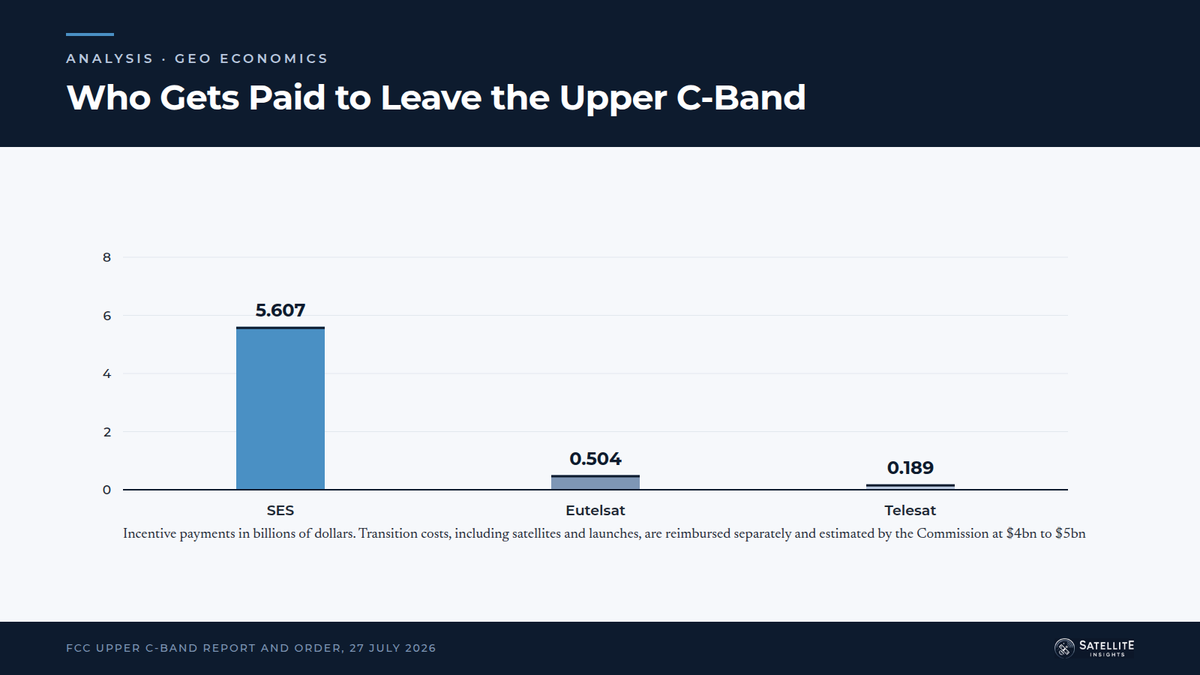
Upper C-band incentive pool split between SES, Eutelsat and Telesat under the FCC order released 27 July 2026
160 MHz
Spectrum cleared in the contiguous United States, 3.98 to 4.14 GHz plus a 20 megahertz guard band
$600M+
Contract value for three geostationary communications satellites over roughly thirty months, customer undisclosed
5 Nov 2026
Deadline for eligible space station operators to file initial transition plans with the Commission
Why would anyone order three GEO satellites in 2026?
Because clearing spectrum means replacing the satellites that carried it, and the Commission agreed to pay for them. On 27 July the FCC released its Upper C-band Report and Order, clearing 160 megahertz across the contiguous United States. Three operators split $6.3 billion in incentive payments for vacating it: SES $5.607 billion, Eutelsat $504 million, Telesat $189 million. Separately from those incentives, incumbents are reimbursed for the reasonable and necessary costs of the transition, and the Commission has been explicit that this covers the cost of satellites, launches and the work required to clear the band. It estimates those transition costs at $4 billion to $5 billion. Four weeks later, Intuitive Machines disclosed a contract for three geostationary communications satellites worth more than $600 million over roughly thirty months. The customer is not named, and the company will not say whether the order relates to C-band at all.
The incentives are the part that got reported. The mechanism underneath them is the part that matters to anyone modeling the manufacturing base, because a reimbursement schedule that names satellites and launches as eligible costs is a regulator underwriting a procurement cycle rather than merely creating conditions that happen to require one.
What follows works through why a three-satellite order runs against the direction of travel in geostationary orbit and yet fits it exactly, what the contract value does and does not represent, why the customer is being withheld and which operators the short list contains, whether the same program was announced twice in five days, and the dated filing in November that will settle the question.
The remaining five sections are free with an email address.
No payment, no card. An email address unlocks the rest of this analysis and everything after it. If you already have an account, sign in and the page opens where you are.
- 02Who still buys geostationary satellites
- 03What $600 million actually buys
- 04Why the customer will not be named
- 05Was this announced twice
- 06What would confirm the reading
Independent weekly intelligence on the satellite communications sector. No hype. A point of view. Unsubscribe in one click.
Is anyone still buying GEO capacity in 2026?
Enough people to make this the largest commercial geostationary manufacturing award in recent memory, which runs against the direction of travel.
The prevailing account of geostationary orbit is a business in managed decline, with operators retiring capacity they cannot fill and redirecting capital toward low Earth orbit. Telesat's second quarter is the clean illustration: geostationary revenue down 26 percent, utilization at 60 percent and falling.
A three-satellite order does not overturn that account so much as identify its exception. Demand for new geostationary capacity here is not coming from growth, it is coming from obligation. Clearing 160 megahertz means moving the services that currently ride on it, and in geostationary orbit moving services means procuring spacecraft with lead times measured in years. Operators face a primary clearing deadline of 31 December 2030 and a final one of 30 June 2031.
That is a replacement cycle, not a recovery. The distinction matters for anyone modeling the manufacturing base, because a replacement cycle has a floor, an end date, and in this case a reimbursement schedule.
What does a $600 million order actually cover?
Three spacecraft on the Intuitive Machines 1300 platform, designed, manufactured, integrated and supported, over roughly thirty months.
The platform itself deserves a pause, because the 1300 is the former Maxar bus, which passed through Lanteris and into Intuitive Machines, and that production line has flown for decades carrying a substantial share of the world's geostationary communications fleet. Its survival through two ownership changes is itself a finding: the industrial capacity to build large geostationary spacecraft in the United States did not disappear when the order book thinned. It changed hands.
One caution on the number, which matters more than it sounds. More than $600 million over thirty months is contract value and schedule rather than recognized revenue or cash. The company recorded a $45.0 million authority to proceed during the second quarter, and that is the portion actually authorized to start work.
Why would a buyer stay anonymous on an order this size?
Chief executive Steve Altemus was asked directly on the second-quarter call by Deutsche Bank's Edison Yu and declined, saying he would give more color in future. The company says program details remain confidential at the customer's request.
Anonymity in a commercial satellite order is not unusual on its own. What makes this one worth noting is the combination of a named platform, a named value, a named schedule and no customer. That pattern usually means the buyer has a reason to control announcement timing, which in turn usually means the purchase is tied to something the buyer has not finished disclosing.
If the C-band reading is right, the candidate list is short, because the same three operators receiving incentive payments are the ones who have to move services off the band. That is inference and should be read as such.
Did the same program get announced twice in five days?
On 13 August, the second-quarter results disclosed the three-satellite contract and stated the program was already recorded in backlog at 30 June, with the $45.0 million authority to proceed received during the quarter.
On 17 August, Intuitive Machines issued a standalone release announcing it had received an authorization to proceed from an undisclosed customer on a multi-satellite communications infrastructure program with an anticipated value of more than $600 million, on the same 1300 platform. The shares rose roughly 9 percent that day, with some accounts putting the move nearer 6 percent.
The second release does not say three, and does not say geostationary. It does carry the same value, the same platform, the same customer confidentiality and the same description. The most economical reading is that both refer to one program, with the August authorization a fuller tranche on work already booked four days earlier.
Read that way, the backlog is stated correctly and counts the program once, while the move came on a program the market had already been told about. Intuitive Machines has not confirmed the two are the same, so treat the connection as strongly indicated rather than established.
What would settle whether this is C-band replacement capacity?
There is a dated answer coming, because eligible space station operators must file initial transition plans with the FCC by 5 November 2026. Those plans have to describe how each operator intends to clear the band, which means describing the capacity that replaces what is being vacated. A plan calling for three new geostationary spacecraft would close the question.
Failing that, a named customer whenever the buyer chooses to disclose, or an Intuitive Machines statement separating the program from C-band outright, which would kill the theory rather than confirm it.
Until 5 November, the honest position is that the timing fits, the arithmetic fits, and the company has said nothing either way.
The company the market is misreading
Intuitive Machines completed its acquisition of Goonhilly Earth Station and the Communications Satellite Corporation (COMSAT) on 3 August, adding teleport and ground-network assets. The following day L3Harris selected it to build eighteen spacecraft platforms for a Space Development Agency tracking program. Nine days after that came the second-quarter results and a record $1.8 billion backlog. Then the communications authorization, then a National Aeronautics and Space Administration (NASA) Jet Propulsion Laboratory selection for an Earth science mission.
Five announcements in sixteen days, spanning ground infrastructure, national security, commercial geostationary and civil science. Most coverage still files this company under lunar landers.
Whether that adds up to a coherent infrastructure strategy or an opportunistic one is a fair question, and one worth asking now rather than after the next acquisition. It is not a lunar story either way.
On method: every figure here comes from the 13 August release, the 17 August release, the FCC Upper C-band Report and Order of 27 July, or management's remarks on the second-quarter call. Contract values are identified as contract values and not as recognized revenue. The link between the 13 and 17 August announcements is identified as inference. Share prices, market capitalizations and analyst price targets are excluded as a standing rule.
The intelligence behind the headline numbers.
Satellite Insights publishes independent weekly analysis on satellite operators, constellations and ground networks, from a forty-year enterprise satcom practitioner. This week's Deep Dive works through the $6 billion contest for Grain Management's 800 megahertz and the Commission rule that makes two of its promised outcomes mutually exclusive.
Become a member


