Is iDirect a Smart Buy?
ST Engineering marked its ground-segment champion to a floor and opened a strategic review. Here's what a buyer would actually get — and what it's worth.

Analysis | Ground-System Consolidation · Tuesday, 14 July 2026
Is iDirect a Smart Buy?
Pricing a ground-segment champion after the S$667m reset — what a buyer is really acquiring, and what it's worth.
Is iDirect a smart buy? Not a yes/no — it's for whom, and at what price. ST Engineering has already told the market what iDirect is worth to it.
Q1Is iDirect a smart buy?
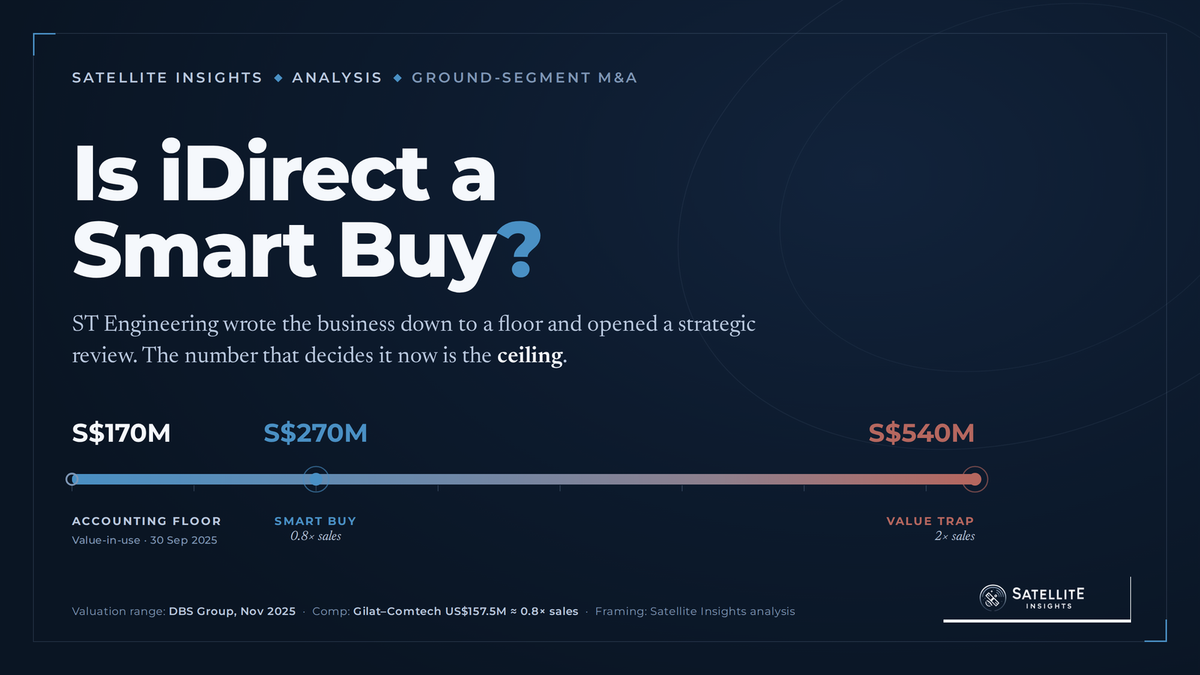
After a S$667 million non-cash impairment in November 2025, ST Engineering marked the iDirect group down from a S$837 million carrying value to a S$170 million Value-in-Use as of 30 September 2025 — a discounted-cash-flow figure with the losses and GEO decline already priced in. But that S$170m is an accounting floor, not a sale price. A negative-EBITDA, negative-book asset gets sold on EV/sales, and DBS pegs the likely range at S$270–540 million. The Gilat–Comtech deal — around 0.8x sales — marks the distressed low end. So the real question isn't whether S$170m is cheap; it's whether iDirect at S$270–400m is a bargain or a trap, and that turns entirely on which of three assets you think you're buying: a melting annuity, a defense crown jewel, or an option on multi-orbit.
Q2Why is ST Engineering selling iDirect?
Because the market it was built for is migrating away from it. iDirect posted a 9% revenue decline and a 22% EBITDA decline over the first nine months of 2025, on top of an EBIT loss of S$89 million for FY2024. Headcount was cut more than 20%, from about 1,400 in 2022 to 1,100 in 2024, for S$60–70 million in annual cash savings — which management conceded was still not enough to reach profit.
The parent is openly evaluating "strategic options," which the sell-side reads as a sale; DBS, CGSI and OCBC all raised their ST Engineering targets partly on that expectation. Yet the divestment they modelled for the first quarter of 2026 hasn't closed. As of publication no transaction has been announced — a slippage that may reflect the 1Q26 revenue turn softening the urgency to sell cheap.
One more piece of context a buyer will weigh: who's steering iDirect through the review. Sridhar Kuppanna was appointed CEO on 30 March 2026, succeeding Don Claussen, with a brief to keep pushing the Intuition-led modernization. A leadership change mid-review cuts both ways — a fresh execution mandate on one side, strategic discontinuity to diligence on the other.
Q3What is iDirect worth?
Three numbers bracket it. The S$170m VIU is the accounting floor. DBS's S$270–540m EV/sales range is the likely transaction zone. And the freshest real-world comp — Gilat's June agreement to buy Comtech's Satellite & Space Communications unit for US$157.5 million cash, cash-free and debt-free, on roughly US$195 million of revenue, i.e. about 0.8x sales, for a profitable, U.S.-defense-weighted peer — marks where a distressed ground-segment asset actually clears.
iDirect, loss-making and shrinking, belongs nearer that 0.8x low end than the 2x top. Whatever the final figure, it lands below what ST Engineering invested to build the franchise — the Newtec acquisition alone was roughly €250m (~S$383m) in 2019, before the original 2005 iDirect purchase and years of R&D.
A ground-segment champion assembled over fifteen years, exiting for less than it cost to build.
Q4What would a buyer actually get?
Three distinct assets that don't sell for the same multiple. First, an installed hub-and-modem annuity — sticky GEO and mobility customers across broadcast, maritime and aero, with real switching costs and ground platforms supporting SES and others. Durable cash, but a melting annuity as GEO loses share.
Second, the defense/sovereign crown jewel — iDirect Government, formed in 2007 for the U.S. government and defense communities, plus cleared programs and sovereign-SATCOM positioning. The most defensible piece, and precisely what Gilat just paid up for in Comtech. Cleared U.S. ground-segment capability is scarce and commands premiums.
Third, the multi-orbit option — the cloud-native Intuition platform, its G&S SatConnect service layer, and 5G NR-NTN work (demonstrated in showcase settings, not yet proven at commercial scale), where customer adoption has been taking longer than expected. An option, not a cash flow.
The wildcard sits on top: within ST Engineering's Urban Solutions & Satcom segment (revenue up 18% to S$525m in 1Q2026), the Satcom line — iDirect at its core grew more than 30% year-on-year, with cost cuts on track. Two caveats keep it honest: that figure is the Satcom line within the segment, not an iDirect-standalone number, and it's top-line revenue from a business update, not profit. Real inflection, or a bounce off easy comps and cost-out? That single question decides whether S$270m is cheap.
Q5Who would buy iDirect?
A defense-focused consolidator or PE defense platform is the natural fit — carve out iDirect Government, run the commercial GEO base for cash, treat Intuition as a cheap embedded option. Gilat is the closest strategic match but the least likely near-term buyer, still absorbing Comtech and having funded that deal from cash.
A multi-orbit or sovereign operator — a Telesat Lightspeed, an SES-type integrator, a regional sovereign player — could value Intuition as a control plane it would rather buy than build, though most LEO players build their own ground, thinning that field. A pure financial buyer works only near the floor.
▸The verdict
iDirect is a smart buy for a defense-anchored consolidator nearer the S$270m / 0.8x-sales end, who values the cleared-government franchise and treats the commercial GEO base as a declining-cash annuity and Intuition as an option. It becomes a value trap toward the S$540m / 2x-sales end, where you'd be paying a growth multiple on a loss-making, shrinking asset on the hope that multi-orbit restores the old economics — in a market whose value is migrating to operators who don't buy third-party ground systems at all (NGSO revenue share is projected to run from ~24% in 2024 to ~75% by 2032).
The +30% 1Q26 print is the whole diligence question: prove it's structural and S$270m looks like a steal; find it's a cost-cut bounce and even the floor is generous.


