SpaceX's 800 MHz Deal Is a Tower Deal
SpaceX's Grain spectrum will run on towers and rooftops, not satellites. Why that makes American Tower, Crown Castle and SBA the deal's early winners.

SpaceX’s 800 MHz Deal Is a Tower Deal
SpaceX’s agreed purchase of Grain Management’s 800 megahertz licenses comes with Federal Communications Commission construction deadlines, and for terrestrial deployment SpaceX’s own filing describes radios on towers and rooftops. So far the companies with the most to gain own the towers.
Up to 14 MHz
Paired low-band spectrum nationwide in the Grain portfolio, and less in some counties.
1 Jul 2029
First construction benchmark: 33 percent of each license’s population or 25 percent of its geography.
5 Nov 2026
Deadline for Grain’s satellite-partner selection to conclude and be notified to the regulator.
0
Tower leases SpaceX has announced for the 800 megahertz network.
SpaceX’s purchase of Grain Management’s 800 megahertz (MHz) spectrum is, on the evidence so far, more a deal for towers than for satellites. The licenses SpaceX agreed to buy on 8 October come with Federal Communications Commission (FCC) construction deadlines, and for terrestrial deployment SpaceX’s own filing describes radios on towers, rooftops and other structures (company-stated). SpaceX has kept a satellite option open as well, but the FCC has not yet cleared the band for satellite use, LightShed Partners doubts SpaceX will put the band on its satellites, and New Street Research notes it does not work with SpaceX’s current direct-to-device satellites. The companies with the most to gain so far are the ones that own the towers: American Tower, Crown Castle and SBA Communications.
Why did tower stocks rise on a satellite company’s spectrum deal?
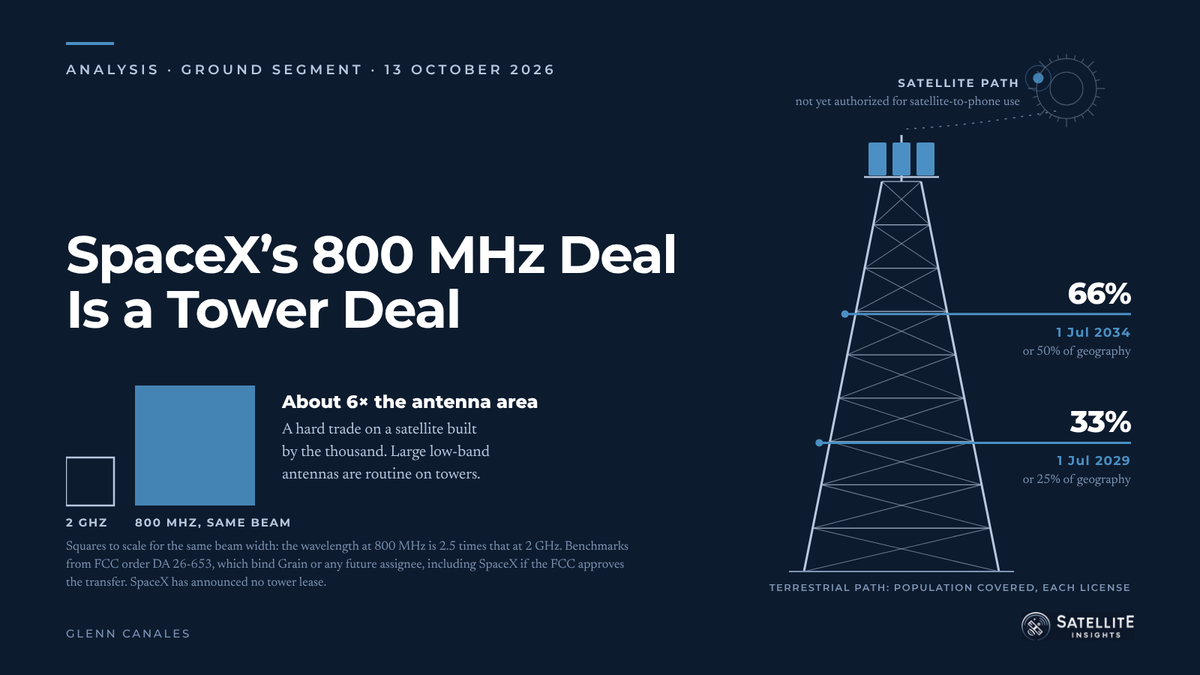
Low-band spectrum such as 800 MHz needs large antennas, which suits towers far better than satellites built in volume. To use the spectrum and meet the FCC’s deadlines, SpaceX has to build or rent a terrestrial network, and much of that means renting space from American Tower, Crown Castle and SBA Communications, alongside independent tower owners and rooftops. The FCC still has to approve the transfer of Grain’s licenses to SpaceX, and SpaceX has not signed a tower lease.
The remaining seven sections are now open to everyone.
This analysis went to subscribers first on 13 October and is now public. New analysis reaches subscribers the week it publishes, and an email address is all it takes.
- 01Why tower stocks rose
- 02What SpaceX bought
- 03The FCC construction deadlines
- 04800 MHz on satellites?
- 05What SpaceX must build on the ground
- 06Dish’s old network
- 07What to watch
Independent weekly intelligence on the satellite communications sector. Unsubscribe in one click.
Why did tower stocks rise on SpaceX’s spectrum deal?
Because the deal makes SpaceX a plausible new tenant. Tower companies are paid per tenant on each site, so a new carrier that rents space on existing towers adds revenue without new construction. All three began rising in extended trading on 8 October, and on 9 October Crown Castle closed up 15.6 percent, American Tower 9.3 percent and SBA Communications 7.3 percent. The carriers whose customers SpaceX would compete for fell the same day.
The last new national network to rent their space, Dish Wireless, is winding down in bankruptcy, and American Tower, Crown Castle and SBA are pressing about US$7.6 billion in lease claims against it. A bankruptcy judge has paused that litigation for settlement talks until 4 November.
Bernstein’s Madison Rezaei made the tower case the evening the deal was announced. Across a range of coverage scenarios, Bernstein puts the cost of a SpaceX ground network at between US$50 billion and US$130 billion, needing 30,000 to 120,000 sites. It estimates that the United States builds only about 1,200 to 2,000 new towers a year, so a network of that size would have to lease space on existing structures. Rezaei added a caveat: “Buying spectrum is not a commitment to build a nationwide network.”
What did SpaceX actually buy?
The portfolio is the band at 817 to 824 MHz paired with 862 to 869 MHz, up to 14 MHz of paired spectrum nationwide, and less in some counties. Neither company disclosed a price, and the Wall Street Journal reported about US$8 billion in cash, citing people familiar with the matter.
Nextel built its push-to-talk network on the band, and Sprint later reused it for Long Term Evolution (LTE). After the T-Mobile and Sprint merger, Dish held an option to buy it for US$3.59 billion, paid US$100 million to extend the deadline, then wrote the option down to zero in early 2024, according to EchoStar’s 10-K for 2023, and let it lapse that April. Grain agreed to buy it from T-Mobile for US$2.9 billion in cash plus Grain’s 600 MHz licenses, the FCC approved that transfer in July, and the deal closed in August. Grain’s original pitch for the band was private networks for utilities and critical-infrastructure operators, and the FCC’s approval noted the potential for use by direct-to-device (D2D) operators, private utilities and other enterprises. SpaceX told the FCC that the licenses support no competitive wireless service today (company-stated).
What do the FCC’s construction deadlines require?
The licenses arrive with the obligations the FCC attached when it approved Grain’s purchase in July, and those obligations travel to SpaceX. The FCC set interim and final construction milestones of three and eight years, shorter than the six and twelve years Grain first asked for, and the order lets the licensee meet them on a terrestrial path or a satellite path, chosen license by license.
On the terrestrial path, which is the default, each license must deliver broadband service of at least 5 MHz by 5 MHz of LTE to 33 percent of its population or 25 percent of its geography by 1 July 2029, and to 66 percent of its population or 50 percent of its geography by 1 July 2034. Under the order, missing the interim date cuts the final deadline from eight years to seven, missing the final date “results in automatic termination of the license and the inability to regain it,” and Grain or anyone who buys from it “may not engage in ‘license-saver builds,’” the minimum-footprint construction that keeps a license alive without serving anyone. The order states that the obligations bind “Grain or any future assignee.” Those conditions matter to tower owners, because they mean any terrestrial build has to be a real network rather than a token one.
On the satellite path, benchmarks for signal quality, uplink throughput and spectral efficiency fall on 30 November 2029, 2031 and 2036. That path needed Grain to run a competitive selection of a satellite partner through a neutral advisor, finish it and notify the FCC by 5 November 2026, and have complete satellite applications on file by 4 December 2026. The order states that the band is not allocated for supplemental coverage from space (SCS), and it deferred the waivers that satellite use requires until those applications arrive. SpaceX says the selection conditions are met in this case (company-stated). The order also lets a licensee that misses one path’s interim benchmark but meets the other’s switch technology on that license afterward.
For tower owners, that election sets the size of the opportunity, since a license built out from towers means leases and one satisfied from orbit needs fewer of them.
Will SpaceX put 800 MHz on its satellites?
SpaceX says it is filing with the FCC’s Space Bureau to add the 800 MHz frequencies to the authorization for its next-generation Starlink Mobile constellation, which it describes as designed to use a wide variety of frequencies (company-stated). That is a design claim, since SpaceX has not flown a payload in this band, and the 15,000-satellite authorization the FCC granted on 6 October covers the spectrum SpaceX is buying from EchoStar, not 800 MHz.
LightShed’s Walt Piecyk wrote that he doubts SpaceX will bother putting the spectrum on its satellites, because low-band frequencies need massive antennas that do not suit satellites produced at scale, and that he expects 800 MHz to become the base layer of a terrestrial network. New Street Research noted that the band is not compatible with SpaceX’s current first- or second-generation D2D satellites.
The physics explains the skepticism. The wavelength at 800 MHz is about two and a half times longer than at 2 GHz, so matching the beam size of a 2 GHz array, and with it the number of beams that can reuse the spectrum, takes roughly six times the antenna area. Low band from orbit can be done: AST SpaceMobile serves phones on AT&T and Verizon low-band spectrum from satellites whose arrays span nearly 2,400 square feet (company-stated). That is a hard trade on a satellite SpaceX is building by the thousand, and a routine one on a tower.
What does SpaceX need to build on the ground?
SpaceX’s filing says that for terrestrial deployment it will operate standards-based equipment, with radios feeding sectorized antennas on towers, rooftops and other structures (company-stated). Low-band macro sites cover the most people per site, and the 2029 benchmark can be met on population covered, so in my view rented macro towers are the fastest route to a third of each license area in under three years.
In August, before the Grain deal, Elon Musk said SpaceX could deploy “a large number of sort of small stations” instead of “very expensive and difficult-to-locate large cellular base stations,” and Gwynne Shotwell described femtocells housed in the same hardware as a customer’s Starlink dish (company-stated). Those remarks predate the 800 MHz purchase, and SpaceX’s 8 October filing lists towers alongside rooftops, which suggests the low-band layer will lean on sites the earlier plan was built to avoid.
Handsets are already in place, since the band sits inside LTE Band 26, which Sprint used for its 800 MHz network and which phones have supported for years, so SpaceX’s statement that most existing devices already support the band is plausible (company-stated). A terrestrial 800 MHz layer does not wait on a replacement cycle, which is the constraint this newsletter’s August sizing report found on the 2 GHz side.
What the band adds little of is capacity. A three-sector site running one 5 MHz carrier at an assumed 1.5 bits per second per hertz carries on the order of 20 megabits per second of downlink, shared across everyone it covers. That is the author’s illustration under a stated assumption, not a measured figure, and it describes a coverage layer: a great deal of voice and messaging, a modest amount of data. Evercore ISI’s Kutgun Maral called the deal more of a coverage fix than a capacity solution, and MoffettNathanson’s Craig Moffett still holds that SpaceX needs a mobile virtual network operator (MVNO) agreement with one of the three national carriers to compete with them.
Capacity therefore has to come from somewhere else, most likely, in my reading, small cells on SpaceX’s 2 GHz spectrum. Our August report, “Satellites Are the Cheap Part,” concluded that SpaceX’s mobile network is limited by cell sites rather than by spectrum or satellites. This deal moves part of that site problem onto macro towers, the most rentable site inventory in the industry, which makes coverage the easier half of the build. The capacity half still needs small-cell sites, on rooftops, poles and SpaceX’s own customer premises.
Could SpaceX buy Dish’s old wireless network?
LightShed’s Piecyk has argued that SpaceX should pick up the radios from the legacy Dish Wireless network, calling it a “cheap no-brainer” [1S]. Dish Wireless filed in July to sell substantially all its assets, including more than 144,000 radios on more than 24,000 tower sites, with EchoStar named as stalking-horse bidder, and its fate remains unsettled. SpaceX has not shown any public interest in the Dish assets. If it did, existing equipment, some of it still on towers and some in warehouses, would shorten the path to the 2029 benchmark, and many of those sites sit on towers owned by the same three companies.
What to watch
- 5 November 2026. The deadline for Grain’s satellite-partner selection to conclude, which puts SpaceX’s selection on the record.
- 4 December 2026. The deadline to file for D2D authorization on the 800 MHz licenses, after which the FCC can take up the satellite waivers it deferred.
- FCC approval of the transfer. SpaceX has asked for expedited treatment.
- The first tower lease. A colocation agreement between SpaceX and American Tower, Crown Castle or SBA Communications would be the first evidence that the terrestrial build has started.
- 4 November 2026. The end of the court-ordered pause in litigation between Dish Wireless and the tower companies, and any sale of the Dish radios. Whether SpaceX bids.
- The license-by-license election. Each license built from towers adds leases, and each satisfied from orbit needs fewer.
In the United States, SpaceX’s carrier plan now leans on towers. Europe’s rules for the same business are a harder problem, covered in this week’s Deep Dive, “SpaceX’s Carrier Playbook Meets Europe’s 2 GHz Rules” (currently members only; it will age out to public).
On method. Construction obligations are quoted from the FCC’s order DA 26-653 of 1 July 2026, the primary document, corroborated by SpaceX’s public interest statement of 8 October and by Broadband Breakfast and Light Reading. Statements by SpaceX are labeled company-stated. The per-site capacity figure is the author’s illustration under a stated assumption. Single-sourced items are flagged [1S].
Related reading: “Satellites Are the Cheap Part: Sizing SpaceX’s Mobile Network” (public), “Grain’s Buyers Need a Rule Change, Not Just a Waiver” (public), and “The Independent and Regional Satellite Ground-Segment Layer: A 2026 Map” (public).
This analysis reached subscribers first. The next one goes out Tuesday.
One free article every Tuesday on satellite operators, spectrum and the ground segment, plus the public preview of every Deep Dive. An email address is all it takes.