Grain's Buyers Need a Rule Change, Not Just a Waiver
Bids for Grain Management's $6 billion 800 megahertz portfolio go to Grain, not the FCC, and close 5 November. The Commission will let AST SpaceMobile test in this band tomorrow, but has created no way for anyone to sell commercial service in it.

Grain’s Buyers Need a Rule Change, Not Just a Waiver
Bids for the $6 billion 800 megahertz portfolio go to Grain, not to the Commission, and close on 5 November. The Commission will let AST SpaceMobile test in this band tomorrow. It has not created any way for anyone to sell commercial service in it, and that gap sits above every other question in the contest.
5 Nov 2026
Deadline set by the Commission for Grain's competitive solicitation to complete
3,224
Counties covered by the 817 to 824 and 862 to 869 megahertz licenses, reaching nearly the entire United States population
6
Applications in the T-Mobile and Grain exchange, running in both directions, granted 1 July 2026
4 Dec 2026
Date by which complete direct-to-device applications are due
Who actually runs the $6 billion 800 megahertz process?
Grain does: offers go to Grain directly, it evaluates them privately, and there is no auction. The Federal Communications Commission (FCC) sits upstream and downstream of the process rather than inside it. It attached the solicitation conditions when it approved the T-Mobile and Grain exchange on 1 July 2026 in Wireless Telecommunications Docket No. 25-178, and it will rule on whatever assignment or lease application comes out the other end. Those conditions set the calendar: open the solicitation within 30 days of closing, complete it by 5 November, and file complete direct-to-device applications by 4 December. Grain has consistently described the outcome as a lease rather than a sale, though the wire has run it as an acquisition.
The exchange itself is worth naming once, because the rest of this turns on it. Six applications were filed on 17 March 2025 and ran in both directions. Three T-Mobile entities assigned the 800 megahertz licenses to two Grain vehicles, Prism License Co 1 LLC and Prism License Co 2 LLC. A Grain subsidiary, NewLevel, LLC, assigned 600 megahertz licenses back to T-Mobile. Cash consideration is reported between $2.9 billion and $3.6 billion. The Commission granted the applications on 1 July and the transaction closed on 11 August.
That is the mechanism, and most coverage has it wrong. What follows is the part that decides the outcome. These frequencies are not among the bands the Commission has made eligible for commercial satellite service, so the winner needs a rule change before a waiver is even reachable. The rule that would then govern the arrangement cuts across the terrestrial buyers Grain has been marketing to since 2025. And the licensing record, two weeks after closing, is completely empty.
The remaining five sections are for paid members.
Independent analysis of the satellite communications sector, written by a forty-year enterprise satcom practitioner. Weekly Deep Dives, research reports, and the regulatory record read directly rather than through the wire.
- 02No commercial pathway exists yet
- 03Where the area rule cuts across
- 04What the AST precedent actually shows
- 05The record is empty, and that is the finding
- 06What settles it, and when
Cancel anytime. Free members continue to receive the weekly free article and the public archive.
What exactly is a satellite operator allowed to do in this band?
Test in it, yes. Sell commercial service in it, no, and that distinction is the constraint sitting above every other one in this story.
AST SpaceMobile holds a 30-day Special Temporary Authority, granted in mid-August and running to 12 September, to test satellite connectivity on 817 to 824 and 862 to 869 megahertz with up to 100 unmodified handsets inside two zones near Midland, Texas and Lanham, Maryland. That is satellite use of this exact band, under Commission authorization, happening now. Experimental and temporary instruments are readily available.
Commercial service is a different question, and the answer to it is currently no.
The Commission's Supplemental Coverage from Space (SCS) framework, adopted in March 2024, lets a satellite operator use spectrum already licensed to a terrestrial carrier so that an ordinary handset can reach a satellite. The framework does not apply to spectrum generally, but only to an enumerated list of bands, and the Commission expressly rejected requests to add others to it.
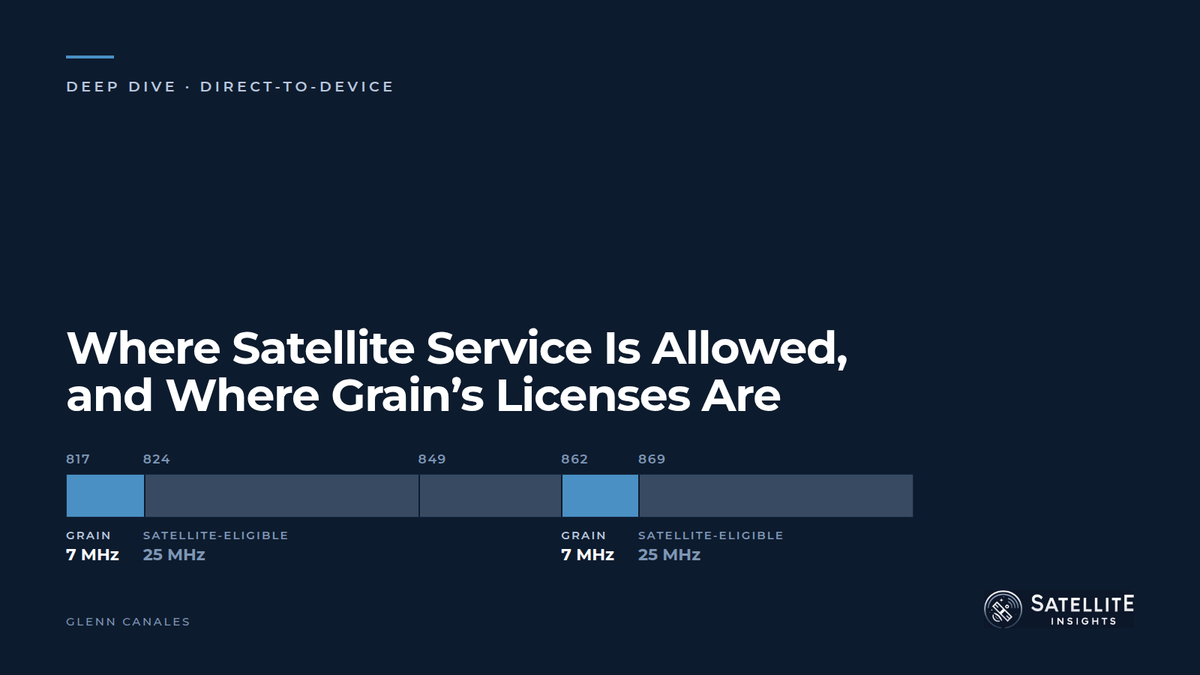
The list is 600 megahertz at 614 to 652 and 663 to 698; 700 megahertz at 698 to 769, 775 to 799 and 805 to 806; 800 megahertz at 824 to 849 and 869 to 894; Broadband Personal Communications Service; and the Advanced Wireless Service H Block.
Grain's licenses are 817 to 824 and 862 to 869 megahertz. That is 800 megahertz Specialized Mobile Radio, the old Nextel and Sprint band. The 800 megahertz entry on the eligible list is 800 megahertz Cellular, a different band held by different carriers.
So the satellite outcome does not begin with a waiver. It begins with persuading the Commission to admit a band it has not previously admitted, which is closer to a rulemaking than to a conditions-attached exception. That is the distance between a temporary test authority and a business. Two facts that otherwise sit unexplained follow directly from this. The Commission set no power flux-density limits for satellite operation in these frequencies, because nothing in the framework contemplated them. And it deferred consideration of Supplemental Coverage from Space relief until a partner is actually identified, because there is no application to rule on until somebody asks.
Why can utilities and a satellite operator not both be served at full scale?
Because of the Geographically Independent Area requirement, and because Grain has been marketing to both sets of buyers since 2025. This is a constraint in the rules rather than a broken commitment by anybody.
A Geographically Independent Area is a defined term in the Supplemental Coverage from Space rules. There are exactly six: the contiguous United States, Alaska, Hawaii, American Samoa, Puerto Rico with the United States Virgin Islands, and Guam with the Northern Mariana Islands.
Under 47 CFR section 25.125(a), a satellite operator seeking to provide Supplemental Coverage from Space must hold lease arrangements with one or more terrestrial licensees that hold, collectively or individually, all co-channel licenses throughout one of those areas. The rule exists because terrestrial spectrum is licensed in small geographic pieces and a satellite beam does not respect county lines. Partial rights would put downlink energy into adjacent co-channel areas whose licensees never consented.
Set that against the marketing plan, because since 2025 Grain has offered this portfolio to utilities, critical infrastructure operators, and rural and regional carriers, and it holds letters of intent from multiple utilities. Letters of intent are not commitments, and nothing here suggests Grain has promised the same spectrum twice. For terrestrial buyers the licenses partition and disaggregate normally. But every county that goes to a party which does not also join the satellite arrangement punches a hole in the contiguous United States footprint, and the $6 billion valuation depends on that footprint being whole.
The rule also closes behind itself, because once a Supplemental Coverage from Space arrangement exists, section 1.9047 bars the terrestrial side from any transaction, including a lease, assignment, transfer, partition or disaggregation, that would leave the satellite partner short of the area requirement.
Utilities and rural carriers were already at odds in this docket over buildout waivers before satellite bidders appeared. One solicitation is running toward two outcomes that constrain each other at every county line, and the rules, not the seller, are what make them incompatible at full scale.
Has any satellite operator cleared this regulatory path before?
Partly, and the distinction matters more than the precedent.
On 21 April 2026 the Commission released DA 26-391, granting AST and Science, LLC authority for a 248-satellite constellation together with the first major commercial Supplemental Coverage from Space authorization. Inside that order it waived sections 1.9047(d) and 25.125(a) subject to conditions. The stated basis was that AT&T does not hold all co-channel licenses in the Lower 700 megahertz A, B and C blocks across the contiguous United States, and that AT&T and Verizon together do not hold all 800 megahertz Cellular co-channel licenses there. AST argued its beam-forming and beam-contouring would protect co-channel incumbents, and the Bureau accepted that it could switch between spectrum blocks quickly enough to make the case work.
The Commission has been explicit that Supplemental Coverage from Space licensing is a hybrid regime: satisfy the entry criteria, or seek a waiver demonstrating no harmful interference, and AST took the second path and won.
But read the bands, because that waiver covers Lower 700 megahertz and 800 megahertz Cellular. It does not cover 817 to 824 and 862 to 869. AST has demonstrated that it can win an area waiver and that its interference case persuades the Bureau, which is transferable experience and worth something in a process whose winner has to convince the Commission the structure works. It has demonstrated nothing about this band, which remains outside the framework entirely.
The test authority described earlier makes the same point from the other side. The Commission will let AST operate in these frequencies on a temporary, controlled, non-commercial basis. It has created no instrument through which AST could sell anything there.
For SpaceX the portfolio would add wide-area voice and rural coverage to a direct-to-cell service currently running on T-Mobile Personal Communications Service spectrum, with EchoStar mid-band pending separately.
What does the licensing record actually show right now?
Nothing, and that is worth stating precisely rather than loosely.
The licenses do not sit under the name in the press releases. Grain Management LLC is the parent and is not a licensee. The 800 megahertz licenses are held by Prism License Co 1 LLC, under FCC Registration Number 0036787919, and Prism License Co 2 LLC, under 0036788156.
Both application records were checked on 23 August and again on 25 August. Both end at the same place they ended two weeks ago: administrative updates granted on 20 August, which are post-closing record housekeeping. The last application on the Co 1 record is 0012158476 and on Co 2 it is 0012159518, and neither has moved since the first check.
No partial assignment appears on either record, which would be the first sign of the portfolio being carved. No spectrum lease notification appears, which is what names a direct-to-device partner. Two weeks after closing, with ten weeks to the bidding deadline, Grain has recorded no commercial arrangement in either direction.
One caution on how to read that, because an empty index supports exactly one claim, which is that no docketed action appears in that view. It does not establish that nothing has been agreed. Commercial negotiations leave no public trace until somebody files.
What would resolve this question, and on what schedule?
Four things, in the order they are likely to appear.
Preliminary offers are due to Grain in the first week of September. That process is private and will produce no public filing, but it is the point at which the field narrows.
A petition to add 817 to 824 and 862 to 869 megahertz to the eligible bands would be the first hard public signal, because it would reveal a bidder's strategy before any transaction is announced. It would appear in the docket or in the Space Bureau record.
Worth noting how quiet that docket currently is. The most recent filing in Docket No. 25-178 was posted on 28 July, three weeks before the bidding contest became public. AST filed an ex parte presentation on 1 July and Grain filed one on 18 June, both before any of this was reported. A $6 billion process with a November deadline is running entirely outside the public record, which is normal for a private commercial solicitation and also means the first public filing will be the whole story.
A partial assignment on either Prism registration number would show the portfolio being carved and would tell you the nationwide footprint is breaking. A spectrum lease notification would name the partner and end the question outright.
Then the two dates the Commission set: bidding completes 5 November, and complete direct-to-device applications are due 4 December, and the Commission has said it will consider applications tied to these licenses even if Grain files after 2026.
The reading offered here is that the band-eligibility problem is the binding constraint and the area rule is the second one, and that together they make Grain's two marketed outcomes incompatible at full scale. That reading is falsifiable. A petition that succeeds in adding the band would remove the first constraint. A waiver structure that carves out utility counties while preserving satellite coverage would soften the second. Neither has been filed as of 25 August.
On method: the process description comes from the Commission's order of 1 July 2026 and the conditions attached to it. Band eligibility comes from the Supplemental Coverage from Space Report and Order. The area rule is quoted from 47 CFR sections 25.125(a) and 1.9047. The AST precedent is read from DA 26-391 directly rather than from coverage of it. Licensing status comes from the application records under both FCC Registration Numbers, checked twice and dated. Market capitalizations and share prices are excluded by standing policy and play no part in the argument.
Also published today.
Somebody just ordered three geostationary satellites and will not say who. The Commission cleared 160 megahertz of upper C-band in July and agreed to reimburse the satellites and launches needed to vacate it. Four weeks later, an undisclosed customer committed more than $600 million. That piece is free to read.
Read the free article


