The Ka-Band Role Reversal: SpaceX Moves to Reopen the ViaSat-3 F2 Grant
SpaceX petitions the FCC to deny ViaSat-3 F2 market access in NGSO-primary Ka-band, filed on day 30 of the recon window. The role reversal, explained.

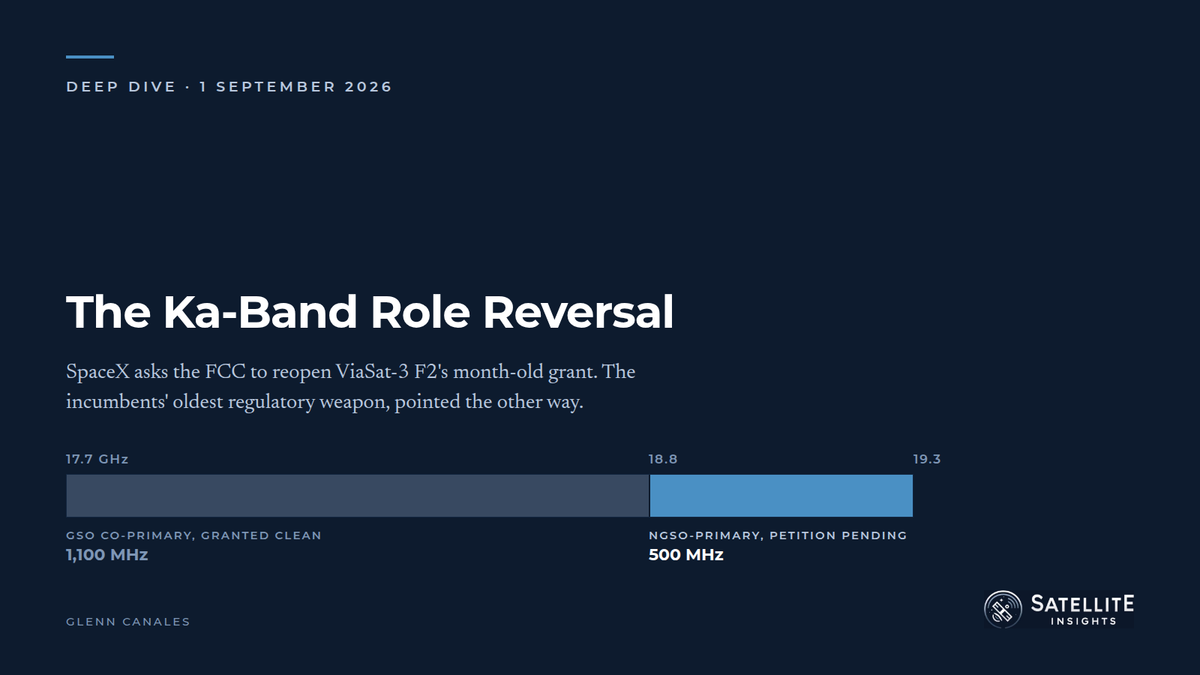
SpaceX Wants the ViaSat-3 F2 Grant Reopened Because, It Says, the Band Belongs to LEO
A petition for reconsideration filed on 28 August, the thirtieth day after the grant, asks the Federal Communications Commission to deny ViaSat-3 F2 the US market access it received in July for two Ka-band segments the rules reserve for non-geostationary systems, on the argument that Viasat has operated there for years without ever completing coordination. For a decade the incumbents used that argument against Starlink, and this week it came back around.
29 Jul 2026
Grant stamp issued for ViaSat-3 F2 US market access at 79 degrees West, with coordination conditions, International Communications Filing System (ICFS) file SAT-PPL-20211207-00172
2 bands
18.8–19.3 GHz down and 28.6–29.1 GHz up, the Ka-band segments the FCC designates as NGSO-primary
Day 30
SpaceX’s petition for reconsideration lands on 28 August, two days before the Section 1.106 window closed, signed by David Goldman
4M+
Viasat terminals SpaceX alleged in a June 2021 Enforcement Bureau complaint were operating in the same bands without meeting pre-operating conditions (allegation, attached as Exhibit A)
Space Exploration Technologies Corp. (SpaceX) has asked the Federal Communications Commission (FCC) to reconsider the United States market-access grant it stamped on 29 July for ViaSat-3 F2, the geostationary orbit (GEO) broadband satellite Viasat launched last November, and to deny that access outright in two Ka-band segments. The petition, filed 28 August in the F2 proceeding under call sign S3113, argues that those segments are primary for non-geostationary orbit (NGSO) fixed-satellite service, the category Starlink lives in, and that Viasat has spent more than half a decade operating in them without ever completing the coordination its licenses require. That is the filing in one sentence, and it is also the reason this is the most significant event of the week, ahead of a busier news cycle around Airbus, Telesat and AST SpaceMobile.
The significance lies not in the interference claim but in who is making it. From the first Starlink applications in 2016 through the Gen2 partial grants and into this year’s fight over equivalent power flux density (EPFD) limits, the GEO operators, Viasat prominent among them, have used coordination and band-priority objections to slow the low Earth orbit (LEO) entrants down. Viasat took the Commission to the D.C. Circuit over Starlink’s altitude modification and lost in August 2022. Now the largest LEO operator on Earth is telling the regulator that a GEO satellite is the one parked in the wrong band, and it is using the incumbents’ own rulebook to say so.
What exactly is SpaceX asking the Commission to do?
Denial of F2’s US market access in two Ka-band segments, 18.8 to 19.3 GHz on the downlink and 28.6 to 29.1 GHz on the uplink, and at minimum an order directing Viasat to cease operating there now. In the FCC’s Ka-band plan those segments are primary for NGSO systems; GEO operators may use them only on a secondary basis after coordinating with the NGSO licensees, and SpaceX says that coordination never happened. The grant already carries a coordination condition; SpaceX’s argument is that Viasat has ignored identical conditions on its earth station licenses since 2017, so a condition is not a remedy. If the Commission agrees, F2 keeps flying but loses those bands over the United States weeks after Viasat filed the paperwork to bring it into service.
One caution belongs on the record before the analysis begins. Every characterization of Viasat’s conduct below is SpaceX’s allegation, drawn from the petition and its 2021 exhibit, and Viasat has not yet filed its opposition. The Commission’s own findings in the grant are identified as such where they appear. And nothing in what follows concerns Viasat’s inflight or government businesses; the lens is enterprise Ka-band capacity and what a buyer of it should do this month.
The remaining four sections are for paid members.
The analysis below covers what the pleading argues and where it is weak, why a priority case is a sharper instrument than an interference case, how the timing lands against F2’s service entry, and the two questions a Ka-band capacity buyer should now put to any GEO provider in writing. Members get every Tuesday Deep Dive in full.
- 02What SpaceX actually filed
- 03Priority beats noise
- 04A satellite waiting to earn
- 05What Ka-band buyers do now
Independent weekly intelligence on the satellite communications sector. No hype. A point of view. Cancel in one click.
What does the petition ask for, and on what grounds?
The document is seven pages of petition over the signature of David Goldman, Vice President of Satellite Policy, plus an eleven-page exhibit, and it wastes no time. The opening sentence accuses Viasat of flaunting wanton, willful and ongoing violations of its license conditions for over half a decade. The relief requested comes in three tiers: reconsider the 29 July grant and deny F2 market access in the 18.8 to 19.3 GHz and 28.6 to 29.1 GHz bands; at minimum, enforce Viasat’s existing conditions and direct it to cease operating there immediately; and, additionally or in the alternative, act on the complaint SpaceX lodged with the Enforcement Bureau in June 2021, which is attached as Exhibit A.
Three arguments carry the petition. First, that Viasat’s application contained no interference analysis at all for the 28.6 to 29.1 GHz uplink, and none of the data (avoidance-angle plots, earth station operating parameters) that would let anyone else run one. Second, that Viasat’s own downlink analysis shows the problem: SpaceX cites Viasat’s Table A.12-1 for the claim that at 7.4 degrees of separation F2 would exceed an interference-to-noise ratio of minus 12.2 dB about one-third of the time in the 18.8 to 19.3 GHz band, the long-term threshold under International Telecommunication Union Radiocommunication Sector (ITU-R) Recommendation S.1323. Third, that no coordination agreement exists, that Viasat has refused to coordinate for years, and that its proposed fix, requiring NGSO systems to hold avoidance angles around its GEO satellite, would invert the priority the Commission wrote into the band plan.
The part that should worry Viasat is what the Commission already said. The 29 July grant partly granted SpaceX’s 2022 petition to deny, found the record insufficient to conclude that Viasat had reached a coordination agreement in these bands, and agreed with SpaceX and Amazon Leo that neither NGSO operator has committed to any specific angular separation, nor is required to. The Commission then attached a condition and granted anyway. SpaceX’s petition attacks that remedy, not the finding: it argues the Commission erred by relying on a condition that mirrors obligations Viasat has, on SpaceX’s account, ignored since 2017. Amazon made the same objection twice in the same file: a Kuiper Systems letter of 21 November 2025, and an ex parte of 16 January 2026, filed under the Amazon Leo brand, recounting a meeting with Space Bureau staff two days earlier. In that filing Amazon said it had yet to reach a coordination agreement with Viasat despite continued and repeated efforts, and asked the Commission to withhold any Viasat authority in these bands, including special temporary authority, until coordination was complete or a technical demonstration approved. The Bureau granted Viasat a 30-day testing STA for F2 in June and market access in July regardless. By grant day, both primary NGSO operators in these bands had said on the record that coordination did not exist, and the Commission had agreed, and had granted anyway.
Where to find it. ICFS file SAT-PPL-20211207-00172, Pleadings & Comments tab, entry PC0116694, filed 28 August 2026 at 17:31 Eastern. The grant, with a date of action of 29 July, went on public notice on 31 July (Actions Taken, Report SAT-02025, DA 26-807), which started the 30-day reconsideration clock of Section 1.106; SpaceX filed two days before it closed. Viasat’s opposition is due within days, not months, so the record will move before this edition ages out of the paywall.
Why is a band-priority case sharper than an interference case?
Here is the part the wire recap will not give you, and SpaceX says it outright in the 2021 exhibit: this is not a mere coordination dispute, and the technical merits of Viasat’s interference showing are not what is at issue. Read the whole filing as a spectrum-priority move wearing an interference costume. Interference cases are slow by design, and everyone in the room knows it. They turn on measurement method, on interference-to-noise thresholds, on which party’s analyzer logged what and under which assumptions, and regulators can defer them for years while the parties trade studies. The 2021 and 2022 appeals by Viasat and Dish Network against the Starlink altitude modification are the proof: the D.C. Circuit upheld the Commission because the challengers’ harm theories did not line up with the binding rules, and the satellites kept launching the whole time.
A priority case has a different shape from the start. If a band is NGSO-primary and a GEO operator has not completed coordination, the GEO operator’s footing is procedurally weak regardless of how quiet its actual emissions are. SpaceX is not asking the Commission to weigh noise, and it says so. It is asking the Commission to enforce its own table, and the exhibit shows how long that argument has been in the drawer. That is harder to wave away with a competing study, and it is a much smarter instrument to bring against Viasat specifically, because Viasat spent years making the interference argument the expensive, deferrable kind.
The 2021 complaint, now resurfaced as Exhibit A, alleges that three Viasat blanket earth station licenses covering more than four million terminals, including terminals aboard aircraft, carried pre-operating conditions in these bands from 2017 onward, that Viasat certified commencement of operations without meeting them, and that SpaceX measured interference from two Viasat satellites at four of its gateways. It further alleges that Viasat presented the Bureau with an email chain from which a critical message had been removed. Those are allegations, unresolved on the record for five years. What the petition does is bolt them onto a fresh Bureau finding that coordination is incomplete, and ask whether a regulator that has already said so should keep granting on conditions. The lever is the one the incumbents pulled on Starlink from the Gen1 fights through this year’s EPFD rulemaking; nothing about the tools has changed, only the direction of fire. The operator that once had the least standing to lecture anyone on band discipline, having launched thousands of satellites under conditional grants and waivers, is now the one demanding it. Regulators notice that kind of symmetry even when they do not say so.
Why does the timing matter more than the law?
ViaSat-3 F2 is not a paper satellite awaiting a launch slot. It lifted off on 13 November 2025 aboard an Atlas V 551, headed for 79 degrees West to cover the Americas. Viasat’s stated capacity for the spacecraft is more than one terabit per second (Tbps), and the company has said F2 more than doubles its fleet capacity once in service. Both figures are company-stated, not independently demonstrated; treat them as design numbers. The regulatory sequence is now on the record: a 30-day special temporary authority (STA) for F2 in-orbit testing in June, the market-access grant with a 29 July date of action, effective on public notice 31 July, and Viasat’s Section 25.172 letter on 10 August, the space station control-arrangements report the rules require to be filed before a market-access satellite commences operation with US earth stations. The sister satellite F3 was guided to commercial service by late summer 2026 in the fiscal 2026 annual report.
So a petition that asks for outright denial in two bands lands eighteen days after Viasat filed the pre-operation report that signals US service beginning, and at the very close of the reconsideration window. That timing is what converts a spectrum lawyer’s argument into a commercial question. The segments in dispute are a slice of F2’s Ka-band plan, not the whole of it, and even a full grant of SpaceX’s request would not ground the satellite. What it would do is remove those segments over the densest part of F2’s market, and do it by reopening an authorization Viasat has held for a month and has already begun to use. The ask for an immediate cease order reaches further, because the same conditions sit on the earth station licenses that serve Viasat’s existing US fleet.
For a GEO operator whose fleet upgrade has already absorbed the F1 antenna failure and a two-year slip, another externally imposed constraint on F2 is not a rounding error. It is the difference between selling the satellite’s designed capacity and selling the capacity a competitor’s petition leaves behind.
What should an enterprise capacity buyer do this month?
Two things, both of them boring and both of them overdue. First, enforce the designed-versus-demonstrated distinction on this bird before signing anything. F2’s designed throughput, per Viasat, is more than 1 Tbps. Its demonstrated, contractable, unencumbered throughput over the United States is now subject to a petition that could limit where and how it operates. If you are negotiating committed information rates on F2 capacity over the Americas, the coordination status of the 18.8 to 19.3 and 28.6 to 29.1 GHz segments belongs in diligence next to the link budget, not after it.
Second, put an explicit price on the regulatory tail risk. Multi-orbit procurement conversations habitually treat GEO as the stable, low-risk layer and LEO as the volatile one. This filing is a reminder that GEO carries its own regulatory tail risk, and that the risk can be triggered by a competitor rather than by physics. Ask any GEO provider, in writing, whether the specific bands you are buying are NGSO-primary and whether coordination is complete and documented. A vague answer is now a line item in the deal.
On method: the band designations come from the FCC’s rules and prior Bureau orders; the launch date and capacity claims from Viasat’s own releases and its fiscal 2026 annual report; the Gen2 authorization count from the Space Bureau’s January 2026 order; and the Amazon objection from SpaceX’s March 2026 opposition filing. The petition and its exhibit were read in full from the ICFS record; every characterization of Viasat’s conduct is SpaceX’s allegation, and the Commission’s findings are quoted from the grant as cited in the petition. Viasat’s opposition had not been filed at press time. Share prices and market capitalizations are excluded by standing policy.
You are reading the member edition.
If this analysis sharpened a decision, two ways to go further. Know someone negotiating Ka-band capacity or tracking this docket? Forward them this edition; the first section is public and the rest is one subscription away. And when a question needs more than a newsletter, Satellite Insights takes a limited number of private briefings and commissioned research engagements each quarter.
Briefings and advisory


