Why stc Group Bought a Satellite Instead of Leasing One
stc group bought a dedicated Astranis small GEO satellite rather than lease capacity. What ownership buys a national carrier, and what it has yet to prove.

Why stc Group Bought a Satellite Instead of Leasing One
Saudi Arabia's largest carrier ordered a dedicated Astranis small GEO satellite on September 11. It flies in a launch seat that was Mexico's until this month, on a mission whose date has moved three times. What owning buys that a lease does not, and what it still has to prove.
5
Satellites on Astranis's Block 3 mission, each for a different customer, launching together on one Falcon 9
7
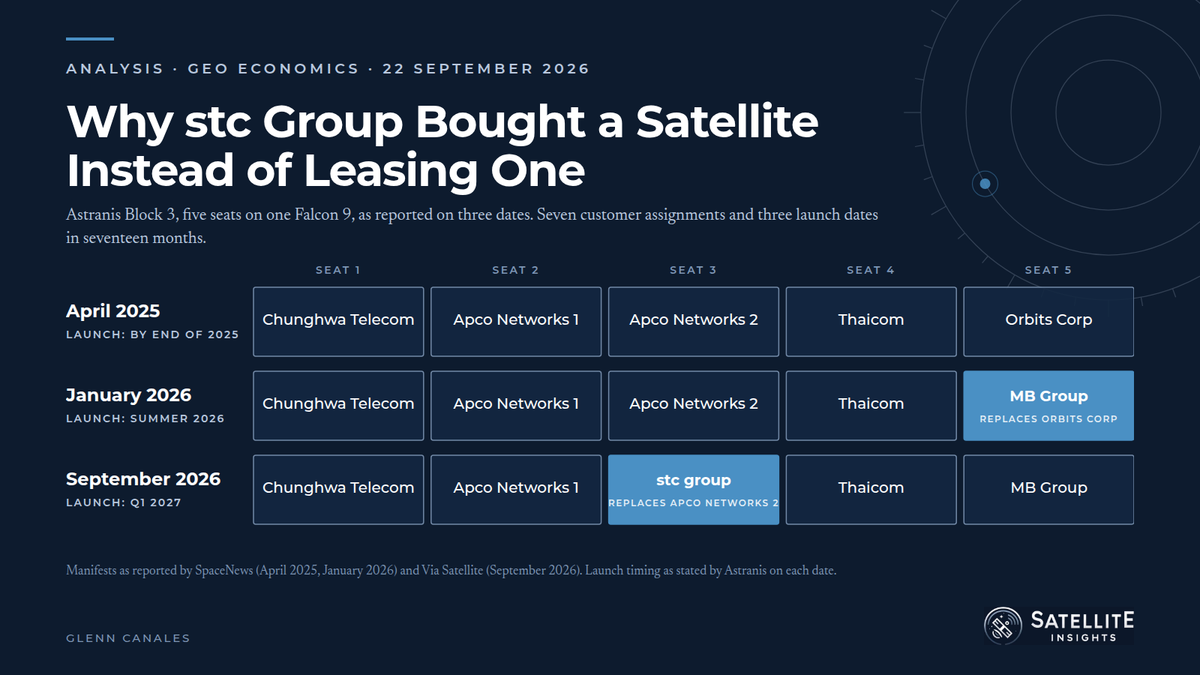
Customer assignments those five seats have held since April 2025, across three reported manifests
Q1 2027
Launch window Astranis now gives for Block 3, first reported for the end of 2025 and then for summer 2026
US$115M
Company-stated value of Astranis's 2025 contract with Chunghwa Telecom. The stc price is undisclosed.
On September 11, stc group, Saudi Arabia's largest telecommunications operator, and Astranis, the San Francisco builder of small geostationary orbit (GEO) satellites, announced that Astranis will deploy a dedicated satellite for the Kingdom. The release describes full stc authority over payload configuration and coverage, data that stays in the region, and a satellite that adds redundancy to a national fiber network. It is the second order of its kind from the Gulf this year, after Oman's MB Group in January. All of that is as announced, and the more interesting detail came a day later, when an Astranis spokesperson told Via Satellite where the satellite fits: on the company's Block 3 launch, in the place of one of two satellites that had been booked for Apco Networks of Mexico.
What did stc group actually buy from Astranis, and when does it fly?
stc group ordered one dedicated small GEO communications satellite, to fly on Astranis's Block 3 mission, a single Falcon 9 carrying five Astranis satellites for five different customers. stc controls the payload configuration and the coverage, and the companies say traffic will stay in the region, though neither has disclosed a price. Astranis says the launch is on track for a window in the first quarter of 2027. The seat stc's satellite occupies on that launch was previously assigned to the second of two satellites for Apco Networks, which Astranis says will now fly on a later block.
So the newest national satellite in the Gulf took over a place in line from a Mexican one, on a mission that has changed its passenger list twice and its launch date three times since April of last year. I do not mean that as a criticism, since it may be the most informative thing anyone has disclosed about how this part of the GEO market now works, and it bears on a question worth asking: why would a carrier with access to every large operator's fleet buy a whole satellite of its own? The rest of this piece looks at what owning buys that leasing does not, how the seat changed hands, what Astranis has demonstrated in orbit as opposed to what it has sold, and what I would want to know before copying stc's decision.
The remaining four sections are free with an email address.
No payment, no card. An email address unlocks the rest of this analysis and everything after it. If you already have an account, sign in and the page opens where you are.
- 02Why own instead of lease
- 03How the seat changed hands
- 04What has flown so far
- 05Where I come out
Independent weekly intelligence on the satellite communications sector. No hype. A point of view. Unsubscribe in one click.