AST SpaceMobile's 2027 D2D Delay — Analysis
AST SpaceMobile pushed direct-to-device service to 2027 and raised a billion dollars. Here is what the delay changes, and what it quietly does not.

Analysis · Direct-to-Device
AST SpaceMobile pushed D2D to 2027. The delay matters less than what it is covering for.
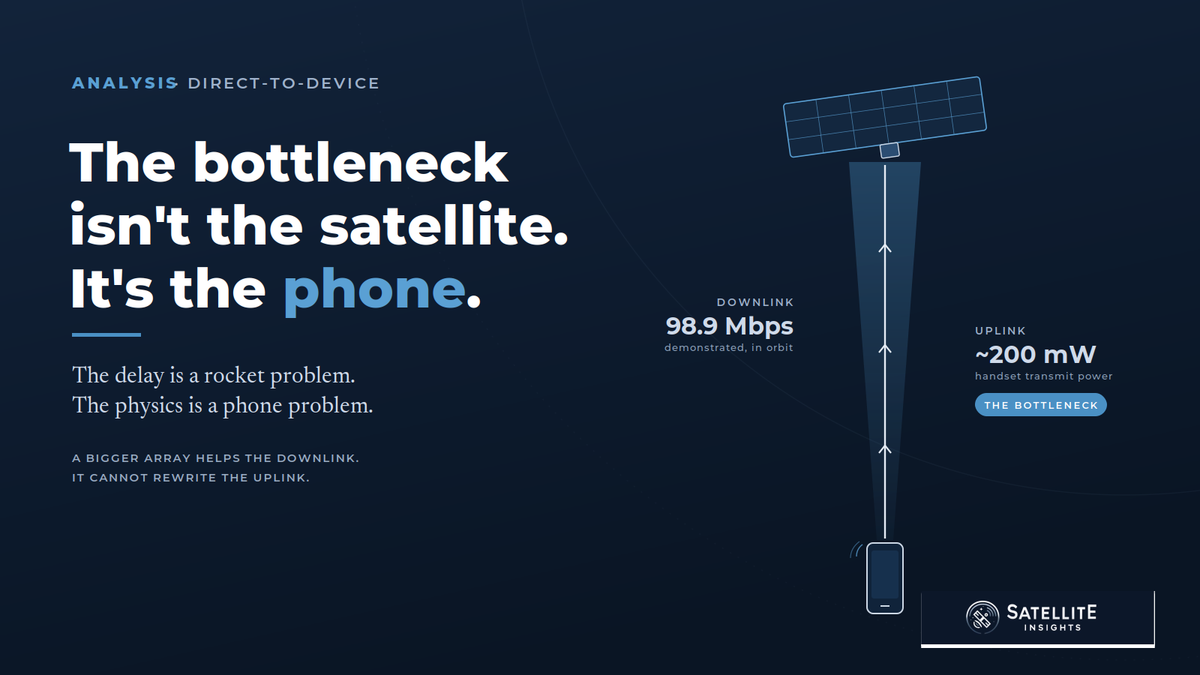
The date slipped because of a rocket. The hard problem is still the phone in your hand.
★ The short version
On July 15, 2026, AST SpaceMobile moved its commercial direct-to-device (D2D) service target to early 2027, from late 2026, and priced $1.0 billion of convertible notes the same day. The market treated the two as one piece of bad news and sold the stock hard.
The delay is real. It also changes less than the headlines suggest, for two reasons: the cause sits upstream in a launch vehicle, not in AST's technology, and the revenue the company actually books does not run through the consumer service that just slipped.
01 / The causeWhy did AST SpaceMobile delay its service to 2027?
Because it cannot fly without rockets, and the rockets had a bad spring. A New Glenn upper stage was destroyed in a static-fire ground test in late May, following the April loss of the BlueBird 7 satellite on the same vehicle. When your service date depends on someone else's vehicle qualifying, your service date is a forecast, not a plan.
AST's published calendars have slipped before. The honest way to price them now is as aspirations with a launch dependency attached, not as commitments. That is not a knock on the engineering. It is a statement about who controls the timeline, and it is not AST.
02 / The physicsWhat is direct-to-device, and where is the real bottleneck?
Direct-to-device (D2D) connects an ordinary, unmodified phone straight to a satellite, with no special hardware in your hand. The constraint is not the satellite. It is the phone. A handset transmits at roughly 200 milliwatts, and that uplink budget is why the physics of D2D favors messaging and telemetry over full broadband, no matter how large the satellite antenna gets.
A bigger array helps the downlink. It cannot rewrite the uplink.
AST's entire bet is that an array big enough bends that math. It is a real bet and worth watching, but hold it to the line between designed and demonstrated: AST has demonstrated a peak near 98.9 megabits per second on the downlink in orbit, while the broadband-to-your-pocket case still has to answer for the uplink coming off the phone in your hand.
03 / The revenueIs AST SpaceMobile making money while the date slips?
The revenue AST books today runs through its ground segment and its government relationships, not through a consumer D2D service that does not commercially exist yet. The company states it has delivered fifteen gateways across five continents, a figure it reports and that is not independently audited, and more than $1.2 billion in contracted commitments.
The billion-dollar raise extends the runway to keep building. So the delay pushes out the consumer headline while the parts that actually generate revenue keep running. That is the piece the stock reaction skated past, and it is the reason the delay reads worse in a headline than it does on the balance sheet.
04 / The tellWhat should you watch next?
The launch, not the financing. Three satellites, BlueBird 11 through 13, are manifested on a Falcon 9 in the first half of August, which would bring the operating fleet to thirteen. That is the next real proof point. Another slip there would tell you more about AST's 2027 timeline than any convertible note ever could.
This is one thread from this week's Satellite Insights Weekly Deep Dive, which ranks the AST story against the rest of the week and ties it to the ground-segment margin question that keeps surfacing across the sector.
Read the full Deep DiveOn the numbers
Throughput figures are marked designed or demonstrated: the 98.9 Mbps peak is a demonstrated in-orbit downlink result, and the broadband case for D2D is a design aspiration. Gateway counts and contracted-commitment totals are company-stated and not independently audited. Share price and market-capitalization figures are volatile and are kept out of this piece by policy; where the stock reaction is referenced, it is described rather than quantified.


