The Delta and Starlink Fight Is About Who Holds the Passenger's Login
Musk says Delta wanted a portal. Delta says the portal was never the problem. Why the loyalty login, not the satellite, decides airline Wi-Fi awards.

The Delta and Starlink Fight Is About Who Holds the Passenger’s Login
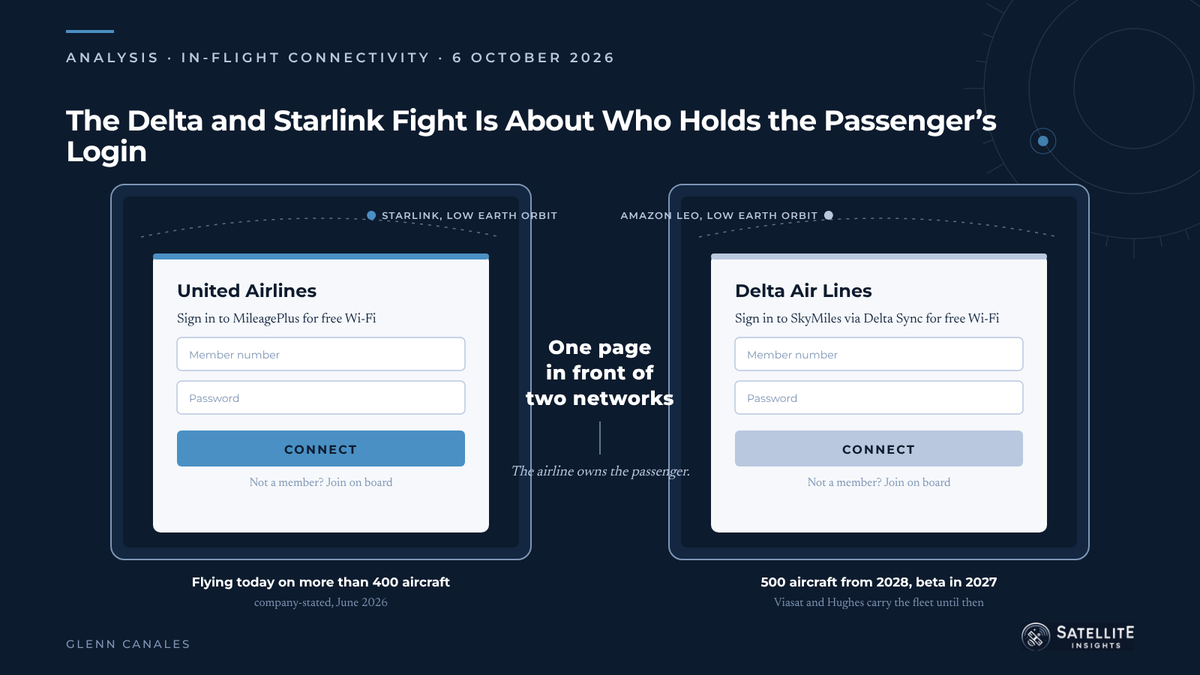
Elon Musk says Delta will regret choosing Amazon Leo. Delta says it chose on price. Both airlines in the comparison gate their free Wi-Fi behind a loyalty account, so the argument is over whose page the passenger sees first, and what that page is worth to an airline.
2028
Year Amazon Leo installation begins on Delta aircraft under the March award, after a 2027 beta
14 May
Date Delta told PCMag that Musk’s portal claim was not accurate and that Delta Sync would have been permitted with Starlink
2
Status-match offers opened to Delta elite members on 1 October, by United and by American
3 of 3
US mainline carriers whose free Wi-Fi requires a loyalty sign-in, whichever satellite sits behind it
Elon Musk spent the last week of September telling the internet that Delta Air Lines’ chief executive will lose his job. The trigger was old news: Delta announced in March that it had chosen Amazon Leo, not Starlink, for roughly 500 aircraft from 2028, and Ed Bastian has defended the choice on cost ever since. What made it a story again was the pile-on. Musk posted on 30 September that the best way to sandbox an artificial intelligence is to put it on a Delta flight, told Bloomberg’s readers on 1 October that Bastian would lose his job over the snub, and Senator Mike Lee called Delta’s Wi-Fi abysmal the same day. United and American both opened status-match offers for Delta elite members within hours. By Friday the aviation press had a feud, and the satellite press had a procurement story dressed up as one.
The procurement story is the better one, and it turns on a word Musk used back in May.
What did Musk say Delta wanted, and what did Delta say back?
Musk said Delta wanted a portal; Delta said the portal was never the problem. On 13 May Musk wrote that Delta had rejected Starlink because it wanted to route passengers through a portal, which would make the service painful, difficult and expensive for its customers. Delta answered through PCMag the next day: the assertion was not accurate, and incorporating Delta Sync with Starlink would have been permitted under SpaceX’s in-flight Wi-Fi agreement. Delta Sync is the airline’s onboard platform, the page where a SkyMiles member signs in to get free Wi-Fi and where Delta places its own content, partner offers and the enrollment prompt for passengers who are not yet members. On Delta’s telling, the dispute was never whether there would be a sign-in but whose sign-in the passenger would see.
The sections that follow take the dispute from the airline’s side of the table: why the login page is the revenue line and the satellite the cost line; how United, Delta and American have each built the same front door in front of two different networks; what the fight looks like to the incumbent that carries Delta’s fleet today; and which of the three things being argued about will decide the outcome.
The remaining four sections are free with an email address.
No payment, no card. An email address unlocks the rest of this analysis and everything after it. If you already have an account, sign in and the page opens where you are.
- 02Why the login matters more than the satellite
- 03Three airlines, three front doors
- 04The incumbent’s read
- 05What the fight is about
Independent weekly intelligence on the satellite communications sector. No hype. A point of view. Unsubscribe in one click.