Iridium Shareholders Said Yes to Rocket Lab. The Stock Is Still $5 Short of the Deal Price.
Iridium stockholders approved Rocket Lab's $54-a-share acquisition on September 24, 2026. What the collar does, why the FCC is the last gate, and why Iridium still trades about 10 percent below the deal price.

Iridium Shareholders Said Yes to Rocket Lab. The Stock Is Still $5 Short of the Deal Price.
The vote on September 24 removed the easy condition. What remains is the Federal Communications Commission (FCC), nine months of calendar, a competitor’s filing in the docket, and a collar that makes Iridium holders part-owners of a rocket company whether they wanted to be or not.
99.6%
Of votes cast in favor on September 24, representing about 81 percent of Iridium’s outstanding shares
$54.00
Notional value per Iridium share: $27.00 in cash plus $27.00 in Rocket Lab stock inside the collar
~$8.0B
Enterprise value at announcement on June 29, 2026, including Iridium’s $1.775 billion term loan
Mid-2027
Expected close, with the FCC’s consent to transfer Iridium’s licenses the one gate still open
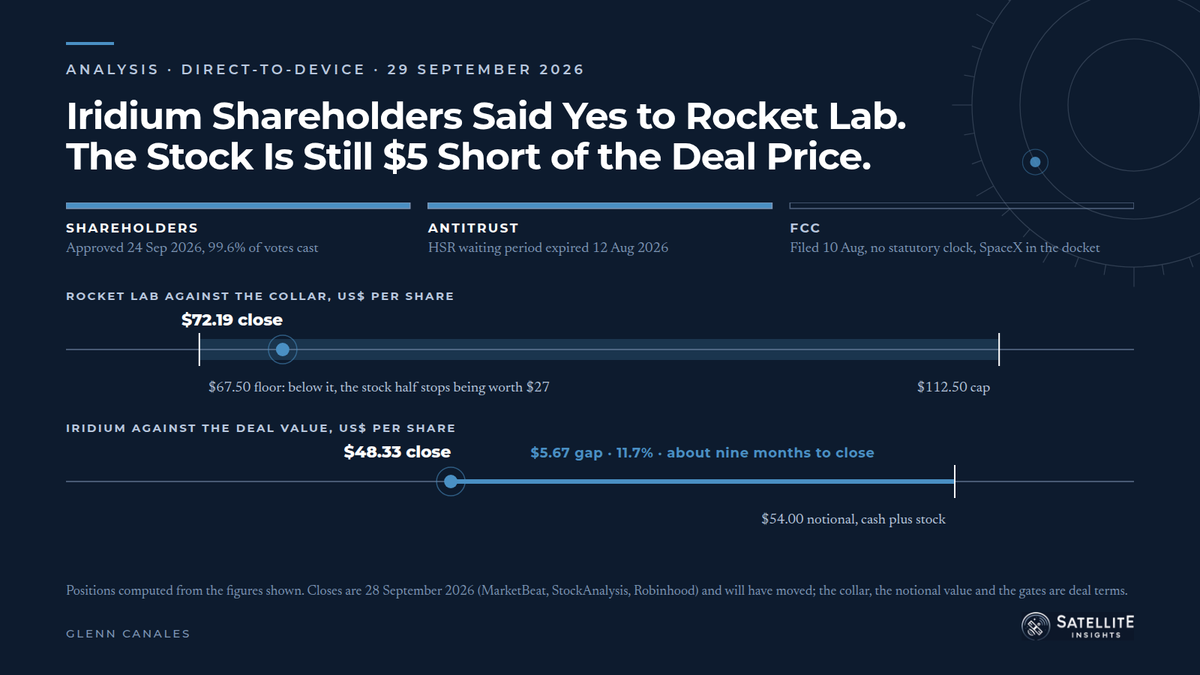
On September 24, 2026, Iridium Communications (IRDM) stockholders approved the company’s acquisition by Rocket Lab (RKLB), with approximately 99.6 percent of votes cast in favor, representing approximately 81.0 percent of Iridium’s outstanding shares. Each Iridium share will receive $27.00 in cash plus Rocket Lab common stock under an exchange ratio subject to a collar, a package with a notional value of $54.00 for each Iridium share.
Is the Rocket Lab acquisition of Iridium done?
Not yet, and the market is pricing the wait. The transaction was announced on June 29, 2026 at an enterprise value of about $8.0 billion, cleared United States antitrust review when the Hart-Scott-Rodino (HSR) waiting period expired on August 12, and is expected to close by mid-2027 once the remaining regulatory approvals, principally the FCC’s consent to transfer Iridium’s licenses, are in hand. Iridium closed at $48.33 on September 28, about 11 percent below the $54.00 notional value.
What follows works through what the vote did and did not settle, the two numbers that describe the price, the collar that decides whether $54.00 is a fixed value or a variable one, why the spread is as wide as it is with two of three gates already passed, what Rocket Lab is actually buying, and what the deal says about who is buying whom in this industry now.
The remaining seven sections are now open to everyone.
This analysis went to subscribers first on 29 September and is now public. New analysis reaches subscribers the week it publishes, and an email address is all it takes.
- 02What the shareholders approved
- 03How much Rocket Lab is paying
- 04How the collar works
- 05Why Iridium trades below $54
- 06What Rocket Lab actually gets
- 07Globalstar, Viasat and SpaceX
- 08What to watch, and where I come out
Independent weekly intelligence on the satellite communications sector. Unsubscribe in one click.
What did Iridium shareholders approve on September 24?
They adopted the merger agreement, and that is the whole of it, which is worth being precise about because the vote is often reported as though it were the deal closing, and it is not. A stockholder vote is one of three gates a transaction like this passes through: the shareholders, the antitrust authorities, and the sector regulator. The first two are now behind Rocket Lab, and the third is the FCC, which does not vote on a schedule set by anyone’s press release.
Approximately 99.6 percent of votes cast, representing approximately 81.0 percent of shares outstanding, is not a contested outcome. It says the holders who showed up saw $54.00 and no better offer coming. Given where Iridium traded at the start of the year, before any of this was public, that is not a surprising read.
How much is Rocket Lab paying for Iridium?
Two numbers apply, and they are not interchangeable.
The per-share number is $54.00 notional: $27.00 in cash and $27.00 in Rocket Lab stock at signing. The headline number is roughly $8.0 billion, which is enterprise value, and the difference between the two is Iridium’s debt. Rocket Lab’s own August 13 update put Iridium’s term loan at $1.775 billion outstanding as of June 30, 2026, and Rocket Lab has a $3.6 billion 364-day senior secured bridge facility from Deutsche Bank and Wells Fargo committed against the cash portion. Rocket Lab also said it would run an at-the-market equity program to reduce what it draws on that bridge, which is a polite way of saying the cash half of the deal is partly funded by selling Rocket Lab shares to the public, before the stock half is funded by issuing Rocket Lab shares to Iridium holders.
What Rocket Lab is buying, in its own words from the June 29 release: an operating business that produced $871.7 million of revenue and $495 million of operational earnings before interest, taxes, depreciation and amortization (EBITDA) in 2025, a 57 percent margin, serving 2.55 million active subscribers through more than 500 partner companies. And the two things that do not show up on an income statement: globally coordinated L-band spectrum, and a constellation that is already flying.
How does the collar work, and why should an Iridium holder care?
The stock component is $27.00 worth of Rocket Lab shares rather than a fixed number of them, as long as Rocket Lab trades between $67.50 and $112.50. Inside that band the exchange ratio floats, so the value stays at $27.00. Below $67.50 the ratio stops floating and fixes at $27.00 divided by $67.50, which is 0.40 Rocket Lab shares per Iridium share, and the value of the stock component falls with Rocket Lab’s price. Above $112.50 it fixes at $27.00 divided by $112.50, which is 0.24 shares, and the value rises.
Rocket Lab closed at $72.19 on September 28 (StockAnalysis; Robinhood shows $73.00 for the same session), which is inside the band and about 7 percent above the floor. At that price the ratio works out to roughly 0.37 Rocket Lab shares per Iridium share and the package is worth its full $54.00. Rocket Lab would have to fall less than $5, a move it has made in a week more than once this year, before an Iridium holder starts losing money on the stock half.
So the collar guarantees $54.00 only within a range, and the range starts uncomfortably close to where Rocket Lab is trading now.
Why is Iridium stock trading below the $54 deal value?
Iridium closed at $48.33 on September 28, down 42 cents on the day, for a market capitalization of about $5.1 billion (MarketBeat; Robinhood). The gap to $54.00 is $5.67, or about 11.7 percent. Spread that across the roughly nine months to a mid-2027 close and the annualized return on holding Iridium to completion is somewhere around 15 percent, before anyone’s cost of capital.
That is a wide spread for a deal that has cleared its shareholder vote and its antitrust review. Merger arbitrage desks price three things into a gap like this. The first is time, and nine months is a long time. The second is the regulator still in the way. The FCC applications to transfer control of Iridium’s licenses were filed jointly on August 10 and accepted for filing in mid-September, which opened the public comment period; SpaceX has already used it. In late August SpaceX asked the Commission to examine Iridium’s conduct toward rival operators, citing what it counted as more than 50 petitions in eight months seeking to block or restrict competing satellite deployments, including Starlink’s next-generation gateways. SpaceX said it does not oppose the transaction itself, and Communications Daily reported on September 24 that Iridium and Rocket Lab were discussing deal conditions with the FCC [1S]. The Commission has no statutory clock on a transfer of this kind, and it now has a competitor on the record asking for conditions. The third is the collar itself: because the stock half of the consideration is exposed below $67.50, anyone holding Iridium is also holding a short put on Rocket Lab, struck near the floor, whether they think of it that way or not. Rocket Lab is a roughly $43 billion company that trades like a growth stock in a sector that spent Monday watching a rocket, and the market charges for that.
None of those three is a signal that the deal is in trouble. All three together are a signal that the market wants to be paid to wait, and 11 or 12 percent is the going rate this week.
What does Rocket Lab actually get: spectrum, Aireon, PNT and NTN Direct?
Strip away the vertical-integration language and the asset list is short.
Spectrum. Iridium’s L-band allocation is globally coordinated and has been for decades, which is the single hardest thing in this industry to acquire by any route other than buying the company that holds it. Every direct-to-device (D2D) constellation announced in the past three years has had to solve the spectrum problem first, by leasing mobile network operator spectrum, by buying a mobile satellite services (MSS) operator, or by asking a regulator for something new. Rocket Lab chose the second route and paid $8 billion for it.
The constellation. Sixty-six operational satellites in low Earth orbit (LEO) at about 780 kilometers, each crosslinked to four others, with a replacement cycle that will eventually need launches and spacecraft. That is the part that makes sense for a company with an Electron on the pad and a Neutron in development: Iridium is a future launch customer that Rocket Lab now does not have to win.
Aireon. The space-based aircraft surveillance business, named in the September 24 release as one of the assets Rocket Lab is acquiring. It is a regulated, long-contract, government-adjacent revenue line, which is the kind of thing that helps when you are carrying a $3.6 billion bridge.
Positioning, navigation and timing (PNT) and NTN Direct. PNT is the alternative to the Global Positioning System (GPS), and NTN Direct is Iridium’s standards-based non-terrestrial network (NTN) effort for D2D. Neither is large today, and both are the reason a launch company wanted a satellite operator in 2026 rather than in 2023.
What does this mean for Globalstar, Viasat and SpaceX?
The structural point is who is buying whom, because in the PanAmSat and Intelsat era, satellite consolidation meant one operator absorbing another, and the manufacturers and launchers stayed suppliers. This year has produced two transactions that run the other way: Amazon’s pending acquisition of Globalstar, announced on April 14 (covered in the September 15 Deep Dive, What Amazon Is Actually Buying at Globalstar), and Rocket Lab’s acquisition of Iridium (assessed at announcement in Bought, Not Built: Why Rocket Lab’s Iridium Deal Isn’t the Next Starlink). In both cases a company that builds or launches things is buying a company that holds spectrum and orbital slots. SpaceX did the same thing without an acquisition, by building the constellation and then buying spectrum from EchoStar.
For Viasat, which owns Inmarsat’s L-band business, the question is whether the remaining independent L-band operator is worth more inside a larger structure than outside one. For Globalstar holders, the Iridium spread is a useful reference for what the market charges to wait on a strategic buyer with a regulator in the path. For SpaceX, an integrated Rocket Lab and Iridium is a smaller version of its own model, which is the highest compliment the industry currently has to offer.
Disclosure. The author was Senior Director of Enterprise Broadband Services at Viasat from 2016 to 2024, serving enterprise and first responder segments in North America. Viasat is mentioned here only as a competing operator. All figures are from public sources.
What has to happen between now and mid-2027?
Three things, in the order they will resolve.
- The FCC transfer-of-control grant, and its conditions
Filed August 10, accepted for filing in mid-September, no deadline attached. Watch the Space Bureau’s public notices for a grant, and read the conditions, because SpaceX has asked for them and conditions on how Iridium may use or defend its L-band would change the value of what Rocket Lab is buying.
- Rocket Lab’s share price against $67.50
The collar floor is the number that turns a fixed-value deal into a variable one, and it is visible every trading day.
- The at-the-market program
How much equity Rocket Lab sells to reduce the bridge tells you how much of the cash half is being paid by existing Rocket Lab shareholders through dilution.
Where I come out
Put the evidence together and it reads like this. The shareholders have voted, the antitrust review is done, the financing is committed, and the one gate left is a regulator with no clock and a competitor already in its docket asking for conditions. The market is charging about 11 percent to hold Iridium through that gate, and on what is public today, that looks like a fair price for nine months of FCC time and a collar with a floor $5 below Rocket Lab’s last close rather than a signal that anyone expects the deal to fail. If the grant arrives clean, the spread closes; if it arrives with conditions on the spectrum, the $54.00 stays the same and what Rocket Lab bought for it does not.
Related reading, all public: Who Gets Bought Next in Satellite M&A, Satellites Are the Cheap Part and AST SpaceMobile’s 2027 D2D Delay.
This analysis reached subscribers first. The next one goes out Tuesday.
One free article every Tuesday on satellite operators, spectrum and the ground segment, plus the public preview of every Deep Dive. An email address is all it takes.