IRIS² Got Bigger and 48 Percent More Expensive. Europe Signed Anyway. — Deep Dive
Rendezvous 1 repriced Europe's sovereign constellation. What the €15.6 billion agreement changes for SES, Eutelsat and buyers of sovereign capacity.

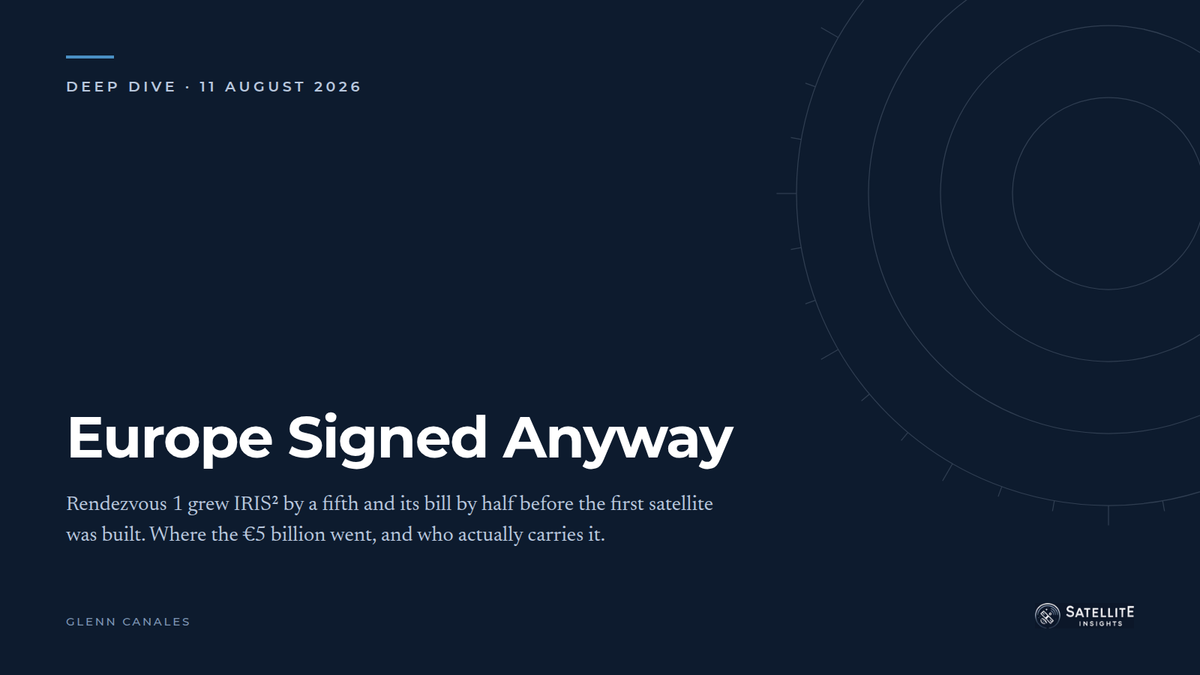
IRIS² Got Bigger and 48 Percent More Expensive. Europe Signed Anyway.
Rendezvous 1 closed last week with 348 satellites and a €15.6 billion estimate, against the 290 satellites and €10.55 billion Europe conceded twenty months ago. The interesting part is not the growth. It is what SES and Hispasat did to wall off their own exposure before signing.
348
Satellites in the expanded IRIS² constellation, 330 LEO and 18 MEO, announced 7 August 2026
€15.6B
Estimated programme cost at Rendezvous 1, against €10.55 billion at the December 2024 concession
+48%
Cost growth in twenty months, before the first production satellite has been built
2029
Target for first launches under the implementation agreement
The European Commission and the SpaceRISE consortium, led by SES, Eutelsat and Hispasat, concluded the Rendezvous 1 negotiation on IRIS² on 6 August and announced it on Friday the 7th, signing the implementation agreement that moves Europe’s sovereign constellation from planning into full-scale deployment. The constellation grows to 348 satellites, 330 in low Earth orbit (LEO) and 18 in medium Earth orbit (MEO), at an estimated cost of €15.6 billion. First launches are targeted for 2029.
Twenty months ago, at the December 2024 concession signing, the same programme was 290 satellites and €10.55 billion.
What did Rendezvous 1 actually change?
The constellation grew a fifth. The bill grew half. And the two commercial operators with the most to lose put hard ceilings on their own money before signing. SES capped its contribution at €1.35 billion, tied to the 18 MEO satellites, with roughly ninety percent of that MEO capacity remaining commercially exploitable by SES. Hispasat capped its commitment at €600 million. Both numbers came out in the operators’ own releases on signing day, which tells you who the message was for.
SES went further and said the quiet part to its investors: its 2026 IRIS² spending already sits inside existing capex guidance, and no future exceptional cash proceeds will be diverted into the programme. That is not the language of a partner expecting the estimate to hold.
Wire coverage on Friday reported the bigger constellation and moved on. The number that deserves the attention is the cost growth, because it arrived before construction, which is when programmes are still supposed to be honest. What follows works through where the €5 billion went, why the operators’ caps change who carries overrun risk, what Eutelsat’s results the same day say about the LEO business underneath the sovereignty story, and the rest of a week that also included SpaceX naming the customers it intends to take and a new FCC docket that widens the direct-to-device (D2D) field.
The remaining seven sections are for paid members.
The full deep dive works through the programme economics, the operator caps, Eutelsat’s numbers, the Starlink Mobile calendar, the new FCC docket, and what Thursday’s Telesat call is actually for. Members get every deep dive, the full archive as it opens, and the weekly intelligence that sits behind the headline numbers.
- 02What Brussels actually bought
- 03Eutelsat’s €297 million line
- 04Starlink Mobile’s 2027 problem
- 05The FCC’s unlicensed D2D front
- 06Telesat on Thursday
- 07Also this week
- 08Method and sourcing
Independent weekly intelligence on the satellite communications sector. No hype. A point of view. Unsubscribe in one click.
Why does the same constellation cost €5 billion more than it did in 2024?
Because it is not the same constellation, and because the concession model is not doing what concession models are sold as doing.
The satellite count moved from 290 to 348, about twenty percent. The estimate moved from €10.55 billion to €15.6 billion, about forty-eight percent. The gap between those two growth rates is the story. Part of it is genuine scope. The added satellites are not spread across the system; they are a dedicated layer of 66 high-LEO spacecraft for defense, security and emergency services, which the Commission says lifts secure governmental capacity by sixty percent inside the EU. A constellation is being asked to carry governmental missions that were aspirational in 2024. Part of it is the familiar physics of a program negotiated between a political customer that cannot walk away and an industrial consortium that knows it.
A concession is supposed to transfer delivery risk to industry. Read the signing-day statements and watch the risk flow the other way. SES capped its exposure at €1.35 billion and attached it to the piece of the system it can commercially exploit, eighteen MEO satellites with roughly ninety percent of capacity available for its own business. That is not a subsidy SES is paying Europe. That is Europe part-funding the refresh of SES’s MEO layer in exchange for sovereign access to it. Hispasat drew its line at €600 million in exchange for exploitation rights in its regions of interest. Eutelsat committed €2.23 billion, the largest operator share of the three, which places the biggest slice of private exposure on the balance sheet least able to absorb surprises. Add the disclosed commitments and the private side totals about €4 billion against €11.6 billion of public money from the Commission and the European Space Agency. That ratio is the honest answer to who owns this program.
Two loose ends are worth writing down now. The prime manufacturing contract for the constellation’s largest segment, the 270-plus high-capacity LEO satellites, is still in competitive dialogue between Airbus Defence and Space and Aerospacelab, so the single most consequential build decision remains open even as deployment formally begins. And the signing-day releases do not agree on the satellite count: the Commission and the European Space Agency say 348, while Hispasat’s own release says 342, six fewer MEO satellites, a discrepancy nobody has reconciled publicly.
The buyers of sovereign capacity should read the caps the same way the operators’ shareholders do. When the people building the system pre-announce the limits of their participation, the residual risk has an address, and it is Brussels.
What is the €297 million line worth?
More than the headline. Eutelsat reported full-year results on the same day it signed Rendezvous 1: revenue of €1,235.9 million for the year to 30 June 2026, down 0.6 percent as reported and up 3.0 percent like-for-like, with adjusted earnings before interest, taxes, depreciation and amortization (EBITDA) of €632.4 million at a 51.2 percent margin. The margin is the miss; the company had pointed to something nearer 52.4 percent, and the stock traded off on the day. Chief executive Jean-François Fallacher answered with a valuation argument, telling analysts the company is undervalued next to what the market pays for Starlink. That is his claim to make.
The line worth keeping is OneWeb. LEO revenue reached €297 million, up 69.5 percent, and now a quarter of total revenue against fifteen percent a year earlier, with management guiding LEO growth above thirty percent again next year. Here is why that matters beyond Paris. Since June, the market has had two audited LEO reference points, one per business model: SpaceX's S-1 disclosed a Connectivity segment blending consumer subscriptions, terminal hardware, Starlink Mobile and Starshield, and Eutelsat's line is the audited read on the other model, what a constellation earns from carriers, governments and enterprises. Amazon still discloses almost nothing. Anyone pricing LEO wholesale and enterprise capacity, on either side of the negotiating table, is triangulating from Eutelsat's number, because the consumer curve does not price a wholesale contract, and this year that number grew fast while diluting margin.
That is the shape of the whole transition in one income statement: the LEO business is real, it is growing, and it is paid for in profitability quality. Eutelsat also confirmed it expects US$504 million in Upper C-band incentive compensation, on the same Federal Communications Commission (FCC) clock that pays Telesat US$189 million and SES considerably more.
Can Starlink take customers from the big three before 2028?
On SpaceX’s 4 August earnings call, the first as a public company, Gwynne Shotwell said the company will build out terrestrial infrastructure around the roughly 65 MHz of spectrum it acquired from EchoStar for US$19.6 billion across two deals, approved by the FCC on 12 May, and make Starlink a true mobile service that takes, in her phrase, quite a few customers from AT&T, Verizon and T-Mobile. She characterized the carriers as a six-hundred-billion-dollar revenue pool. The framing is hers, and it is doing promotional work.
The calendar is less cooperative than the rhetoric. Access to EchoStar’s Advanced Wireless Services (AWS-4) spectrum does not open until November 2027, and the next-generation Starlink Mobile satellites built for the job are targeted for 2027. Tim Farrar at TMF Associates, whose figures are his own analyst estimates and worth reading with that label attached, puts the Starlink Mobile run-rate at roughly US$85 million as of the first quarter and notes SpaceX cannot offer a Band 70 direct-to-cell service on existing US handsets until the AWS-4 access date arrives.
So read the threat for what it is in 2026: negotiating leverage at the mobile virtual network operator (MVNO) and roaming table, aimed at three carriers who can read a spectrum calendar as well as anyone. The time to take the retail threat literally is when the 2027 hardware is flying. Enterprise buyers being pitched Starlink mobility bundles this year should price the service that exists, not the one on the call.
What does unlicensed spectrum have to do with satellites?
As of Wednesday, potentially a great deal. The Commission adopted a notice of proposed rulemaking (NPRM) titled Unleashing Unlicensed Spectrum for Direct-to-Device, FCC 26-51 in new docket 26-169, proposing to let certain unlicensed-band devices communicate with authorized satellites. Every direct-to-device service flying today rides on licensed mobile-satellite spectrum or on terrestrial spectrum leased from a carrier partner. An unlicensed lane would be a third path, and the parties it lets in are the ones who never had a carrier deal: device makers, chipset houses, and internet-of-things (IoT) players who want satellite fallback without a Verizon or a T-Mobile in the room. It is an NPRM, which means it is a question, not a rule. But the question redraws the field, and comment cycles on it will tell you who feels threatened.
The same day’s Daily Digest carried a quieter item with longer consequences: the chairman’s statement thanking the departing chief of the Space Bureau. Leadership turnover at the bureau lands in the middle of the busiest NGSO licensing season the Commission has run, with milestone clocks ticking across several constellations, a subject I took up in the astronomers-versus-the-FCC analysis in July and return to in today’s companion piece on the milestone calendar.
What is Thursday’s call actually for?
Not guidance. Telesat updated its outlook on 4 August alongside the Arctic contract, so when management hosts the second-quarter call on Thursday at 10:30 Eastern, the forward numbers are already on the table. What is not on the table yet is the filing, and the filing is the event. The first-quarter statements carried material-uncertainty language tied to roughly C$2.4 billion of Telesat GEO debt sitting in current liabilities against the December maturity. The single most important disclosure on Thursday is whether that language moves now that December is inside every window that matters.
I wrote up the December problem in last week’s deep dive on the cash position, and the strange geometry of the Arctic award landing at the entity the lenders are suing to reach in Wednesday’s follow-up. Thursday’s filing gets its own read here on Friday, once the going-concern paragraph, the segment cash split and the backlog treatment of the new contract are actually on the record. Until then, treat anything quoted from the call itself as the warm-up act.
Three items that earn a paragraph, not a section
AST SpaceMobile started charging in Japan before it can in the US. On 4 August the company notified the FCC it had initiated commercial direct-to-cell service with Rakuten Mobile on licensed 700 MHz spectrum in Japan, and the following morning a Falcon 9 carried BlueBirds 11, 12 and 13 to orbit, taking the constellation to thirteen spacecraft. Revenue service in Tokyo ahead of commercial authority at home is a neat illustration that direct-to-device is a regulatory geography before it is a technology.
Amazon filed for a second constellation that is not the one you read about. The 24 July application from Kuiper Systems seeks a 5,105-satellite direct-to-device system riding on Globalstar’s L- and S-band spectrum, with the Globalstar acquisition itself still pending. It is a separate animal from the Gen2 broadband expansion approved in January, and conflating the two counts has already muddied more than one report.
The milestone calendar has a date on it this month with zero satellites behind it. A V-band deadline arrives on 26 August requiring a thousand of them, and the public docket is silent. The full non-geostationary satellite orbit (NGSO) deployment-milestone picture is today’s free companion piece: the NGSO Milestone Clock.
How this edition was verified
Every figure in this edition was pulled from a primary document or named publication in the week of publication, not from memory or prior work. Program figures for IRIS² come from the Commission, SES and Hispasat signing-day releases. Eutelsat figures come from the company’s full-year results release and are labeled by reporting basis. Telesat figures come from SEC Form 6-K filings and the Government of Canada award release; Telesat reports in Canadian dollars, its debt is largely denominated in US dollars, and wire aggregators routinely mislabel the two, so nothing here is sourced from an aggregator. Load-bearing claims carry two independent sources; where a figure rests on one source, the text says so. Analyst estimates are labeled as analyst estimates. Statements drawn from court filings are allegations, not findings. Share prices, market capitalizations and credit ratings are excluded as a standing rule.
The intelligence behind the headline numbers.
Satellite Insights publishes independent weekly analysis on satellite operators, constellations and ground networks, from a forty-year enterprise satcom practitioner. Covering LEO broadband, GEO economics, ground segment, direct-to-device and sovereign connectivity. No hype. A point of view.
Manage your subscription