Five Exits From a Band Nobody Flew
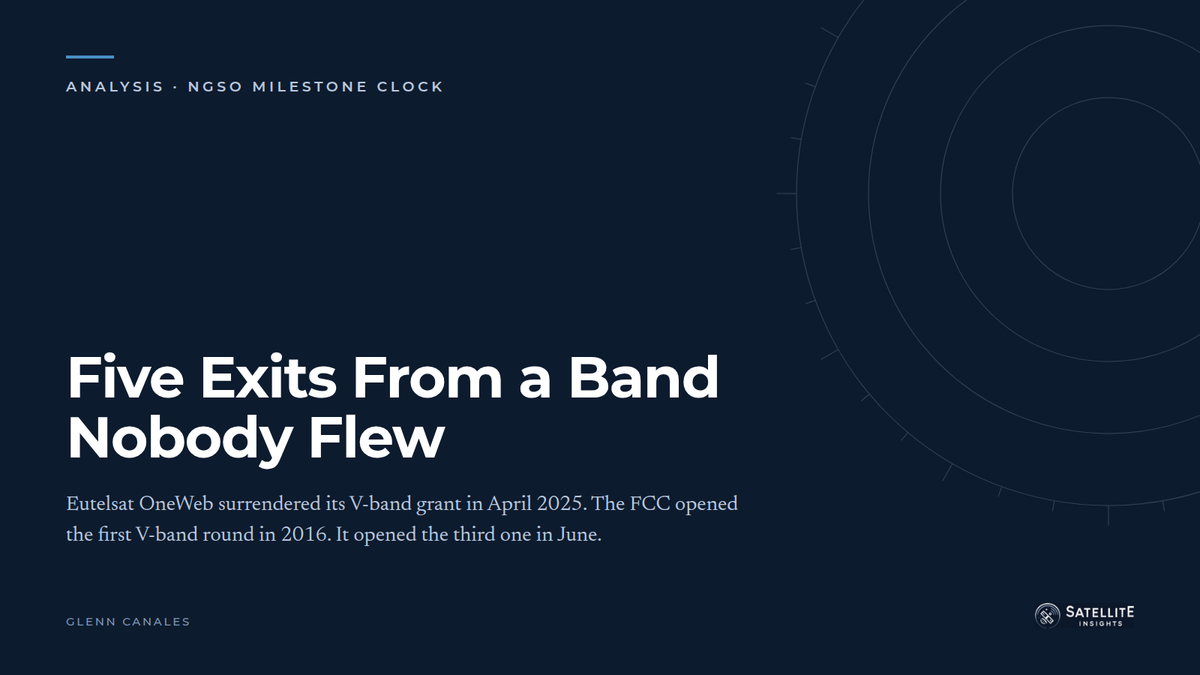
Eutelsat OneWeb surrendered its V-band grant in April 2025. Five operators have now left the FCC's first V-band processing round.

The NGSO Milestone Clock: A V-Band Round That Opened in 2016 and Has Produced Five Exits
Eutelsat OneWeb quietly surrendered its V-band market access grant in April 2025. It is the fifth participant in the FCC’s first V-band processing round to walk away, and the Commission’s own public record still does not present it as gone. This is the register that tracks every deployment clock the FCC has running.
30 Apr 2025
Date Eutelsat OneWeb surrendered its V-band market access grant, call sign S2994
2016
Year the FCC opened its first V-band processing round, on a lead application from Boeing
5
First-round participants that have since surrendered or had their authority declared void
3
V-band processing rounds the Commission has now opened in substantially the same bands
Correction, 21 August 2026. This piece was wrong in its central claim, and the version published on 11 August has been rewritten.
It reported that Eutelsat OneWeb faced a Federal Communications Commission (FCC) V-band deployment milestone on 26 August 2026 requiring 1,000 satellites, and that the public docket showed no extension, waiver or surrender on file. There is no such milestone. OneWeb surrendered the V-band market access grant, call sign S2994, on 30 April 2025. The surrender is recorded in the Commission’s International Communications Filing System (ICFS) against file SAT-MPL-20210610-00078, where the last action reads “Surrender of Authorization” and the application status is closed.
The pre-publication check queried the originating petition, SAT-LOI-20170301-00031, and a third-party mirror of it. Neither carries the surrender. The status of a market access grant is recorded against the file that currently carries the authorization, and this piece did not check there. Sections 01, 03 and 04 have been rewritten. The former section 04, which set out scenarios for what OneWeb might do after 26 August, described a decision the company had taken sixteen months earlier and has been removed. The Ku- and Ka-band system under call sign S2963 is a separate authorization, was never at risk, and is unaffected. The Amazon Leo, Telesat and SpaceX entries are unchanged.
In August 2020 the FCC granted OneWeb, then WorldVu Satellites Limited and in Chapter 11, access to the United States market for a 2,000-satellite V-band system. The grant carried the standard anti-warehousing condition: launch and operate half the authorized system within six years, all of it within nine. On 30 April 2025, counsel for the company filed a letter surrendering the grant. No Commission order followed, and the letter said none was needed.
Is the surrender visible in the FCC’s public record?
Only if you open the right file. Call sign S2994 points at a current authorization of SAT-MPL-20210610-00078, and that file’s detail page carries the surrender: last action “Surrender of Authorization,” last action date 30 April 2025, status closed. The originating petition, SAT-LOI-20170301-00031, still reads as granted. Its most recent document is dated April 2020. The related filings list for the call sign shows nothing after September 2022.
Three of the four ways into this record show a live 2,000-satellite V-band claim. One shows the truth. That is not a small problem for anyone who prices spectrum positions off the public docket.
What follows explains what the milestone rules are for, walks the deployment clock for every major non-geostationary satellite orbit (NGSO) constellation the Commission is tracking, sets out what nine years of V-band processing rounds have actually produced, and documents how this piece got its central claim wrong. Free subscribers read the whole thing.
The remaining four sections are free with an email address.
No payment, no card. An email address unlocks the rest of this analysis and everything after it. If you already have an account, sign in and the page opens where you are.
- 02What the milestone rules are for
- 03The clock, constellation by constellation
- 04What the first V-band round produced
- 05Method, and what went wrong here
Independent weekly intelligence on the satellite communications sector. No hype. A point of view. Unsubscribe in one click.
Why does the FCC take spectrum back from companies that paid nothing for it?
Because NGSO spectrum is not sold, it is claimed. An operator that files for thousands of orbital slots and frequency rights but never builds is squatting on a shared resource and blocking the operators who would. The deployment milestone in 47 CFR § 25.164 is the Commission’s only real tool against that: launch and operate half your authorized system within six years and all of it within nine, or the authorization shrinks to what you actually flew, and the surety bond you posted at grant is forfeit. The bond is the point. It converts an empty filing from a free option into a paid one.
Surrender is the other exit. An operator that knows it will miss can hand the authorization back rather than wait for the clock, which is what Hiber did after missing the same fifty-percent milestone, documented in FCC order DA-22-595. Surrender before the milestone date still costs the bond. What it saves is the enforcement record.
Both mechanisms are being stress-tested right now, and from opposite directions. The launch market cannot absorb every constellation on the Commission’s books, which is why the waiver story in the next section matters. And in July the Commission rewrote the penalty altogether.
Who is on time, who has asked for mercy, and who has already left?
Eutelsat OneWeb, V-band: surrendered, 30 April 2025. The 2,000-satellite claim is gone, handed back sixteen months ago. No V-band payload was ever flown against it. The distinction that matters, and it matters more now than when this register first ran: this touched only the V-band market access grant, call sign S2994. The Ku- and Ka-band system carrying the revenue Eutelsat reports sits under call sign S2963, a separate authorization, unaffected then and unaffected now. What was surrendered was a spectrum claim and the bond behind it, not an operating business.
Amazon Leo, Gen1: due 30 July 2026, missed, conditionally excused. The halfway milestone on the original authorization required 1,616 satellites in orbit by the end of July. Roughly 400 production satellites were flying. Amazon asked for relief in January citing launch-vehicle availability, and on 5 June the Space Bureau granted a conditional waiver in order DA 26-553: the 2029 full-deployment deadline stays, the cap provision is waived, the surety bond is still forfeit, and processing-round priority is stripped from satellites launched after the missed date until March 2028, or October 2027 if Amazon certifies that the satellites are built and the launches procured. Relief went to the operator that could show a factory and a manifest.
And then that remedy became the rule. Seven weeks later, on 22 July, the Commission adopted the Space Modernization Report and Order, FCC 26-47, replacing part 25 with a new part 100. For processing-round NGSO systems the six-year and nine-year schedule survives. The penalty does not. Missing the interim milestone will no longer cap the constellation at what flew; it will reassign the system to the processing round matching the year of the miss. The bespoke fix for Amazon in June is the general rule in July. Part 100 is not yet effective, and the date arrives by Space Bureau public notice, which is a trigger worth watching and one nobody has on a calendar.
SpaceX, Gen2: ahead of the clock, with one loose thread. In January the Commission authorized a second tranche of 7,500 Gen2 satellites, doubling the authorized system to 15,000, and expressly retained the existing milestones of 1 December 2028 and 1 December 2031. The interim requirement went from 3,750 satellites to 7,500 without a single additional day. Deployment rate is why milestone questions do not attach to SpaceX. The thread is V-band: SpaceX filed to modify the bond and milestone conditions on its first-tranche V-band operations in August 2024, against an interim date that had already passed in November of that year, and that modification was still pending when the January order issued without prejudice to it.
Telesat Lightspeed: first milestone missed in 2023, disposition still pending. Telesat’s first-round Ku- and Ka-band market access carried a fifty-percent milestone of 3 November 2023 that the program delays made unreachable. In October 2023 it asked to move the fifty-percent date to 19 March 2028 and full deployment to 10 June 2028, and separately amended its pending second-round application down from 1,671 satellites to 300. The amendment was accepted for filing in March 2025. Neither request has a published decision. Which produces the strangest line in this register: Telesat is building a funded constellation against a United States market access posture the Commission has not resolved in almost three years.
Nine years, one lead application, and how many operating systems?
The Commission opened its first V-band processing round on 1 November 2016, on a lead application from Boeing. Count what is left of the field.
Boeing surrendered in September 2023. Telesat surrendered its V-band petition in November 2021, a separate filing from the Ku- and Ka-band market access discussed above. O3b surrendered in August 2022. Audacy was declared null and void in 2022. OneWeb surrendered in April 2025. That is five participants gone from a round that was meant to allocate a band.
Two more carried interim milestones that have now passed and whose outcomes are not established on the record reviewed here. Theia’s fell on 10 May 2025. Viasat’s fell on 23 April 2026. Both dates come from a party filing rather than the grant stamps, and both should be confirmed against the underlying authorizations before anyone relies on them. This register will carry them once they are.
That leaves SpaceX, which folded its V-band authority into the Gen2 satellites rather than flying the separate constellation it originally proposed, and which is carrying an unresolved milestone modification of its own.
In June 2026 the Commission opened the third V-band processing round in substantially the same bands. The first round is not a cautionary tale about one operator. It is the base rate. When a processing round opens and the filings arrive at scale, the honest prior is that most of them will never fly, and the public record will be the last place that shows it.
How this register is verified, and how it failed
Every date and requirement here comes from a primary FCC document: the granting order, the milestone rule, or a catalogued filing, each listed in the sources rail. Fleet composition is drawn from two independent tracking sources. Satellite counts are dated. Statements about what operators will do are labeled as scenarios, not predictions.
The 11 August version of this piece asserted that no surrender was on file for the OneWeb V-band grant. A pre-publication docket check ran and specifically looked for a surrender. It queried the originating petition, SAT-LOI-20170301-00031, through a third-party mirror. That file shows no document after April 2020 and still reads as granted. The surrender sits on SAT-MPL-20210610-00078, the file the call sign lists as its current authorization, and it is visible only on that file’s application detail page. The related filings view does not show it, because a surrender letter is correspondence and does not receive its own file number.
So the check was performed and the answer it returned was wrong, because the question was aimed at the wrong file and the result was read as proof of a negative. Two rules follow, and both now govern this register. Docket status resolves to the call sign, then to the current authorization file that call sign points at, then to that file’s last action field, in ICFS directly rather than a mirror. And an index that shows nothing supports one claim only, that no docketed action appears in that view. It never supports the claim that nothing was filed.
Thanks are owed to the reporter who brought the surrender letter forward. The register republishes when a tracked docket moves, and it republishes when it is wrong.
The intelligence behind the headline numbers.
Satellite Insights Weekly is independent research on the operators, constellations and ground networks that carry the traffic. Deep Dives publish every Tuesday. Recent editions have covered the economics of Europe’s sovereign constellation and the debt calendar running underneath the geostationary fleet. Start with the IRIS² Deep Dive.
Become a member